| Typ <itemType> |
Objekt/föremål |
| Datering <presTimeLabel> |
Luristan Iron II-III |
| Plats <presPlaceLabel> |
Asien, Iran, Luristan, Lorestan |
| Description <itemDescription> |
-
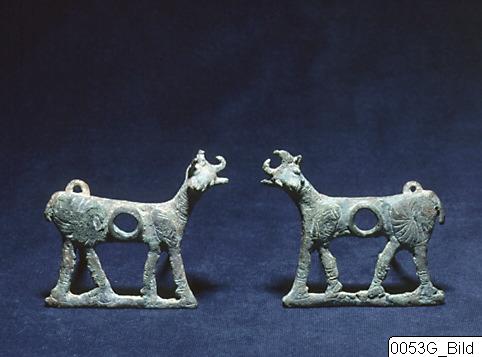
One of two cheekpieces, each cast in one piece, deer-like animals in profile . Body contours are in low relief, the head turned frontally in full relief with bull horns. The horns are short and parenthesis-like. Each piece has a central hole for the mouth piece, two spikes on the back, two loops for cheekstraps along the top, and a single bar ground line. Decor: considerable linear decor on neck, ...
Visa hela
One of two cheekpieces, each cast in one piece, deer-like animals in profile . Body contours are in low relief, the head turned frontally in full relief with bull horns. The horns are short and parenthesis-like. Each piece has a central hole for the mouth piece, two spikes on the back, two loops for cheekstraps along the top, and a single bar ground line. Decor: considerable linear decor on neck, legs, shoulder, and a whirl or "torsional hair star" (Moorey 117) on the haunches.
Stäng
|
| Inventory number <itemDescription> |
|
| Acquisition <itemDescription> |
|
| Comments <itemDescription> |
-
Characteristic of Luristan is the great variety of these cheekpieces cast in large flat plaques as passant animals. Potratz places them in his group V. Similar cheekpieces appear in the reliefs of Sen...
Visa hela
Characteristic of Luristan is the great variety of these cheekpieces cast in large flat plaques as passant animals. Potratz places them in his group V. Similar cheekpieces appear in the reliefs of Sennacherib (794-681 BC) confined to horses associated with the king. It is likely that Assyria adopted them through contacts with western Persia in the eighth century. Variations in style most likely indicate different workshops rather than dating (Moorey). Ours is of the less naturalistic kind with an unusual depiction of a bull-deer. Similar animals may be seen in Potratz who traces their origins to Sumer-Akkadian tradition. The uniqueness and decorative character of the animal might place them closer to the ninth than the seventh century.
Stäng
|
| Condition <itemDescription> |
|
| Conservation / Executed <itemDescription> |
-
Cleaning and conservation report. D-nr 16455013, 950108. General condition. Both parts have similar condition - objects are dirty with soil, clay. There is light green, compact but very porous corrosi...
Visa hela
Cleaning and conservation report. D-nr 16455013, 950108. General condition. Both parts have similar condition - objects are dirty with soil, clay. There is light green, compact but very porous corrosion under the dirt layer. Original surface is almost completely missing, except for few small spots; objects features and ornamentation are rather well preserved. There is no active corrosion. Treatment: cleaned mechanically with scalpel, small soft rotating bristle brush, under magnification. Two consolidate coatings of 10% Paraloid B72 in ethanol are applied on surfaces.
Stäng
|
| Dimensions <itemDescription> |
|
| Exhibitions <itemDescription> |
|
| Cf Publications <itemDescription> |
-
Cf/collection: Moorey 1971: 114-124; nos. 121, 123, 125, 126;
Potratz 1966: 147 pls. 136-138; and several earlier publications.
|
| Publications <itemDescription> |
|
| Exhibition / Previously <itemDescription> |
|
| Country / Findspot <itemDescription> |
|
| Exhibition, Part of / Previously <itemDescription> |
|
| Acquisition, Swedish <itemDescription> |
|
| Händelse <context> |
-
Förvärvad av Békésy, Georg von.
-
Brukad Luristan Iron II-III.
-
Funnen i Lorestan, Iran, Asien.
-
Ägd av Nobelstiftelsen.
|
| Material, engelska<itemMaterial> |
- Metal
- Bronze
|
| Material<itemMaterial> |
- Brons
|
| Nyckelord <itemKeyWord> |
-
Bekesy
-
George
-
Luristan Iron II-III
-
Room 9
-
Västasien
|
| Mått <itemMeasurement> |
-
Height / Höjd: 9 cm.
-
Length / Längd: 9,9 cm.
|
| Object<itemName> |
- cheekpiece
|
| Ämne <subject> |
|
| Inventory number <itemNumber> |
|
| Rättigheter för metadata <itemLicense> |

|
| Källa <presOrganization> |
Statens museer för världskultur - Medelhavsmuseet |
|
Källa <url>
|
|


 ARTIKLAR I WIKIPEDIA
 ARTIKLAR I WIKIDATA
 BILDER I WIKIMEDIA COMMONS