| Typ <itemType> |
Objekt/föremål |
| Datering <presTimeLabel> |
1882-08 |
| Plats <presPlaceLabel> |
Nordamerika, Costa Rica, Koktu |
| Beskrivning <itemDescription> |
-
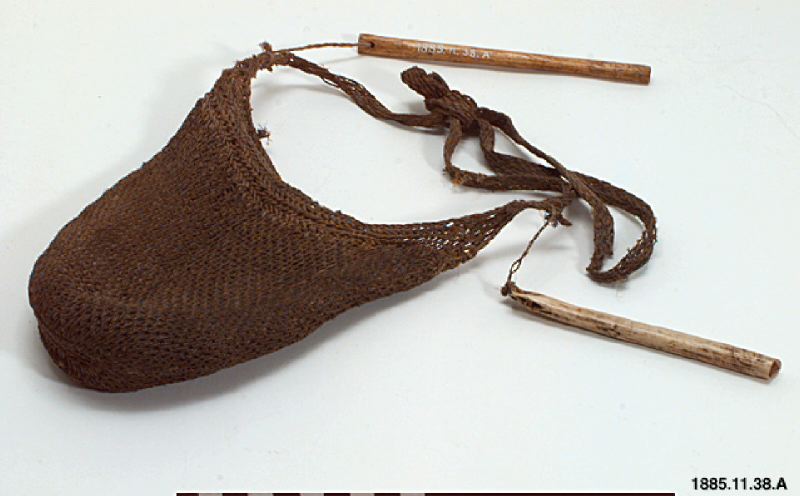
Väskan av bastsnören i två avdelningar att användas vid jakt, den ena för lerkulor, makrobo, att användas för blåsrör (se bild Ymer 1885 s.203) kamokro. Väskan innehåller 10 kulor av lera samt en stor och en liten lerklump. Vid väskan hänger dessutom en laddstock och ett svarvben, bägge av apben.
|
| Beskrivning / engelska <itemDescription> |
-
Information derived from Bribri visit: Sept 28 – Oct 02, 2023. Associated clay/mud balls (1885.11.0038.B-M) are ammunition for blowpipes, and would primarily be used for bird hunting. The ammunition...
Visa hela
Information derived from Bribri visit: Sept 28 – Oct 02, 2023. Associated clay/mud balls (1885.11.0038.B-M) are ammunition for blowpipes, and would primarily be used for bird hunting. The ammunition would be shaped using the bone tools attached to the woven bag (185.11.0038.A). The Bribri describe the maker of this bag as very skilled and likely a member of the clan designated as bag-crafters. The Bribri visitors offered two potential scenarios in which a double-compartment bag would be used. The first explanation is that this bag was dual-purpose, holding medicinal plants and treatments in one compartment and blowpipe ammunition (small, clay balls) in the other. The ammunition would be shaped with the assistance of the attached bone components. A second explanation likely refers to bags with double-compartments that lack accompanying bones - and is a designation of an experienced Awá (traditional healer). The Awá would bear responsibility for carrying sacred stones, known as Siõ, which are assigned either male or female gender – each gender of stone would be kept in its own compartment. The double-compartment bags associated with the sacred stones of the Awá are called Klö́’Skú. Awápa (plural of Awá) who had not yet completed their training would carry only female stones and would need a bag with only one compartment – a Siõ'Skú. Bribri woven bags are typically made from the Cabuya plant (Furcraea cabuya). The leaves are processed by beating and drying the plant material and spinning the fibers (called ‘fique’ by the Bribri) into chord. The darker stripes on these bags are likely remnants of natural dyes, of which browns and reds are those most commonly used by the Bribri.
Stäng
|
| Referens, källa <itemDescription> |
|
| Land / engelska <itemDescription> |
|
| Geografiskt namn / annat <itemDescription> |
|
| Geografiskt namn / annat <itemDescription> |
|
| Händelse / var närvarande vid <itemDescription> |
|
| Händelse / var närvarande vid <itemDescription> |
|
| Händelse <context> |
-
Brukad - 1882-08 .
-
Brukad av Bribri.
-
Ursprung i Koktu, Costa Rica, Nordamerika.
-
Insamlad 1882-08 av Bowallius, Carl Erik Alexander.
-
Förvärvad 1885 .
|
| Material, engelska<itemMaterial> |
- plant fiber
|
| Materialkategori<itemMaterial> |
- växtmaterial
|
| Material<itemMaterial> |
- växtfiber
|
| Teknik <itemTechnique> |
|
| Nyckelord <itemKeyWord> |
-
Bribri People
-
1885.11.0038
-
Bovallius, Carl
-
Bärande och packdon (482)
-
Flätarbeten (285)
-
Jakt och fångst till lands (224)
-
Resor och transporter (480)
-
Samlande, Jakt och Fiske (220)
-
Talamanca
-
Textil, Skinn och Fibrer (280)
-
Ursprungsfolk i Costa Rica
-
Ursprungsfolk i Panama
|
| Mått <itemMeasurement> |
-
Höjd: 16 cm.
-
Bredd: 15 cm.
|
| Sakord, engelska<itemName> |
- bag
|
| Sakord<itemName> |
- väska
|
| Ämne <subject> |
|
| Inventarienummer <itemNumber> |
|
| Rättigheter för metadata <itemLicense> |

|
| Källa <presOrganization> |
Statens museer för världskultur - Etnografiska museet |
|
Källa <url>
|
|

 ARTIKLAR I WIKIPEDIA
 ARTIKLAR I WIKIDATA
 BILDER I WIKIMEDIA COMMONS





