| Typ <itemType> |
Objekt/föremål |
| Plats <presPlaceLabel> |
Asien, Kambodja |
| Beskrivning <itemDescription> |
-
Avklappningen daterar sig till 1960-tal.
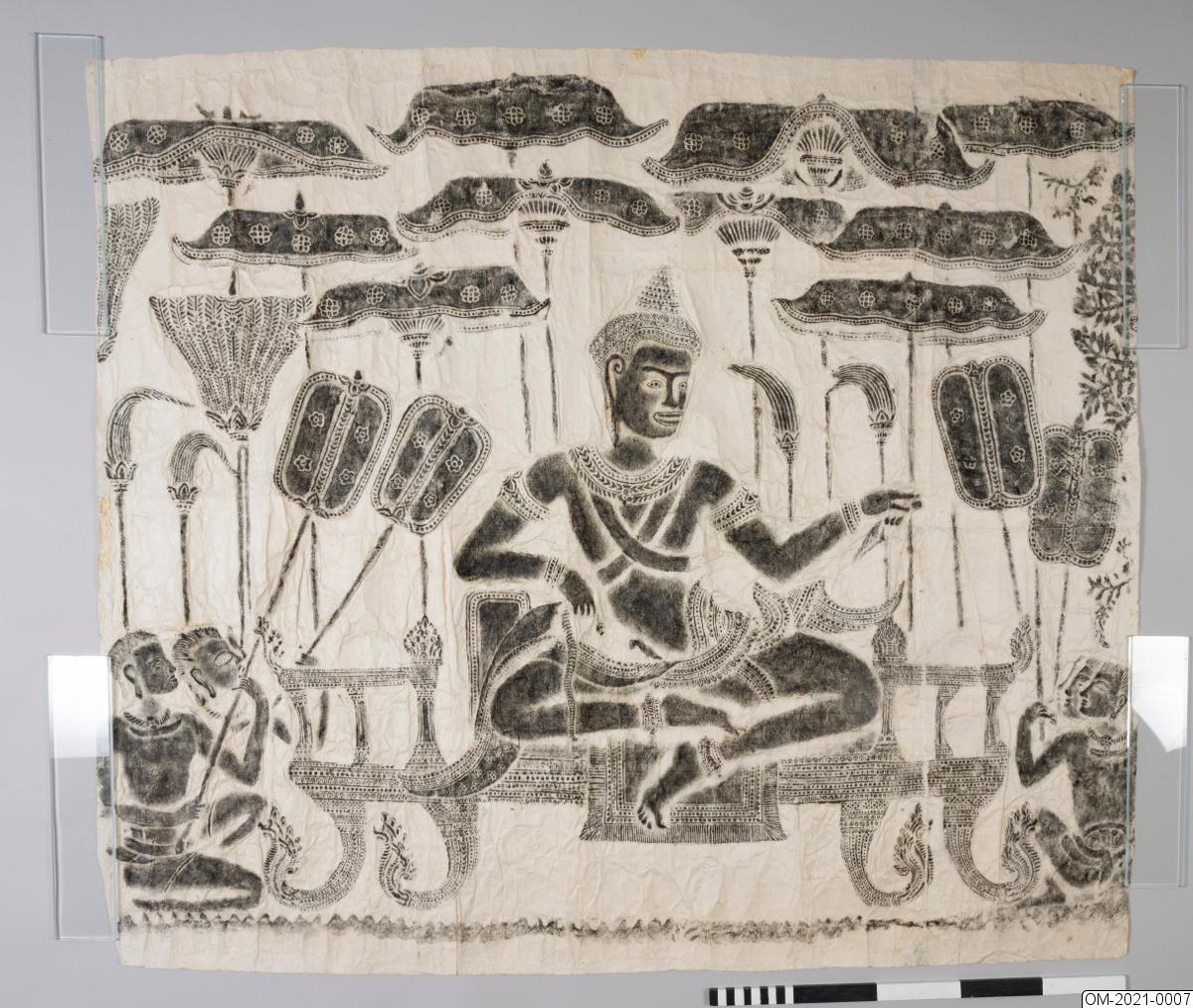
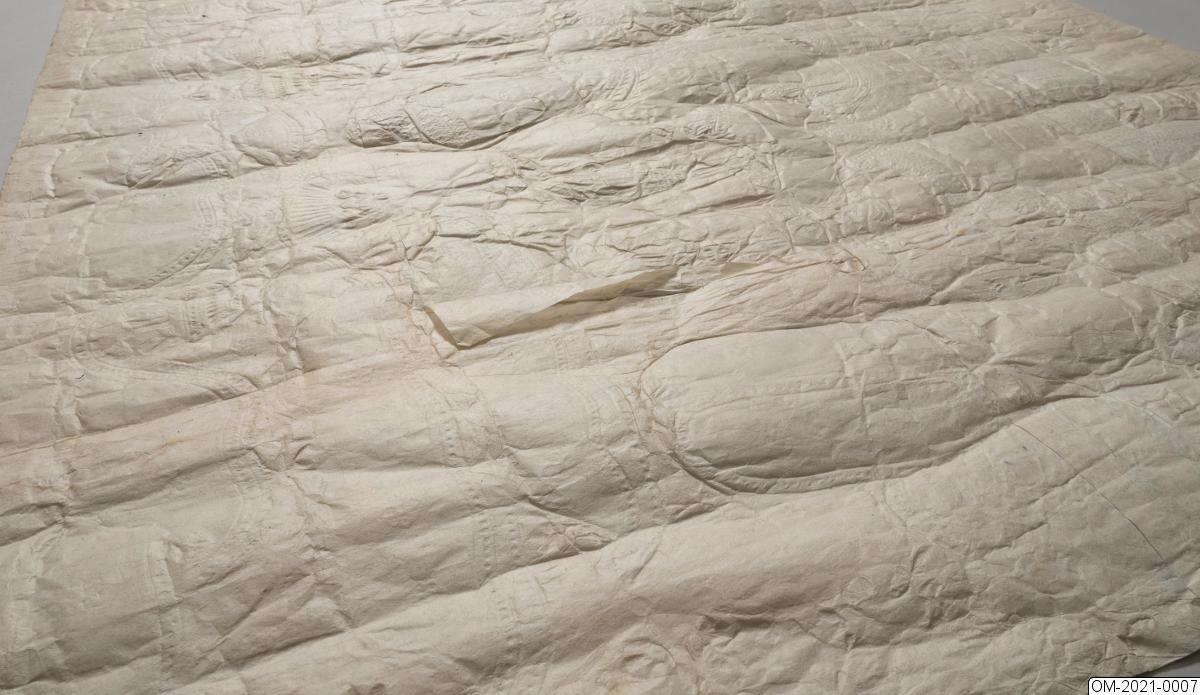
Motivet här är Kung Suryavarman II (ca. 1095 - ca. 1150, regent 1113 – ca. 1150) som sitter på en tronstol på berget Sivapada (Sivas fotavtryck) för att ta emot truppernas hyllning. Kungens höga ställning visas bland annat genom den kungliga huvudbonaden, tronstolen och de många parasoller, solfjädrar och flugviskor som omger honom och genom att han framst...
Visa hela
Avklappningen daterar sig till 1960-tal.
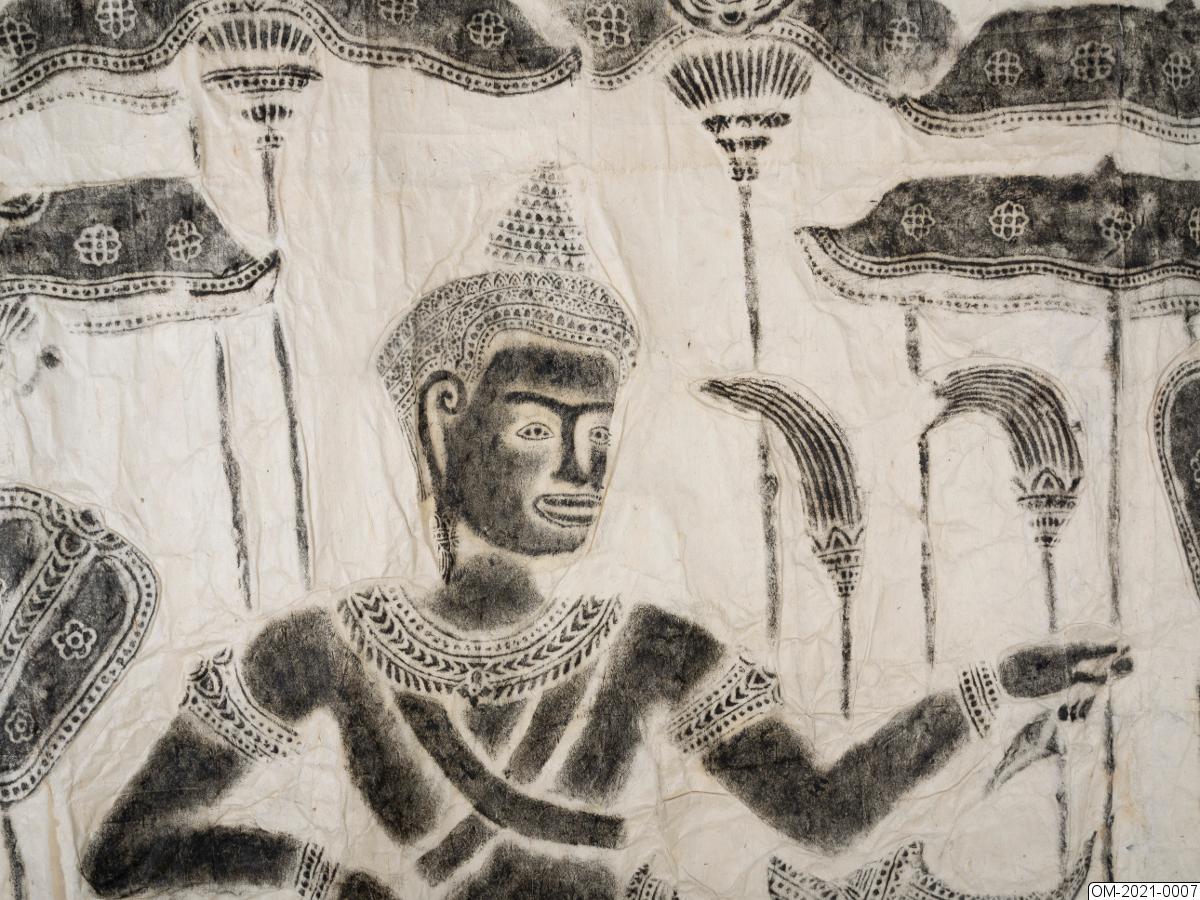
Motivet här är Kung Suryavarman II (ca. 1095 - ca. 1150, regent 1113 – ca. 1150) som sitter på en tronstol på berget Sivapada (Sivas fotavtryck) för att ta emot truppernas hyllning. Kungens höga ställning visas bland annat genom den kungliga huvudbonaden, tronstolen och de många parasoller, solfjädrar och flugviskor som omger honom och genom att han framställts större än de omgivande personerna. Motivet utgör början på vad som benämnts ”Den historiska Processionen”.
Originalet till ”Den historiska processionen” utgörs av en sandstensrelief i templet Angkor Vat belägen i den västra avdelningen av det södra, yttre galleriet. Reliefpanelens totala längd är nästan 100 m. Kung Suryavarman II på berget Sivapada inleder processionen och han avbildas åter i centrum av processionen där varje föregående och efterföljande avdelning leds av en hög representant för provinser i kungens Suryavarman II rike. Reliefen daterar sig sannolikt till mitten av 1100-talet någon tid efter kungens död. En inskription med beskrivande text löper under reliefen.
Angkor Vat är Kung Suryavarman II mausoleum och kungen initierade bygget under sin regeringstid under första hälften av 1100-talet. Templet var helgat åt guden Vishnu, en gudom kungen ansågs vara en manifestation av och att ha förenats med vid sin död och var därför också ett tempel för tillbedjan av kungen. I inskriptionen benämns kungen med namnet Paramavisnuloka (Han som nått den Högste Vishnus rike).
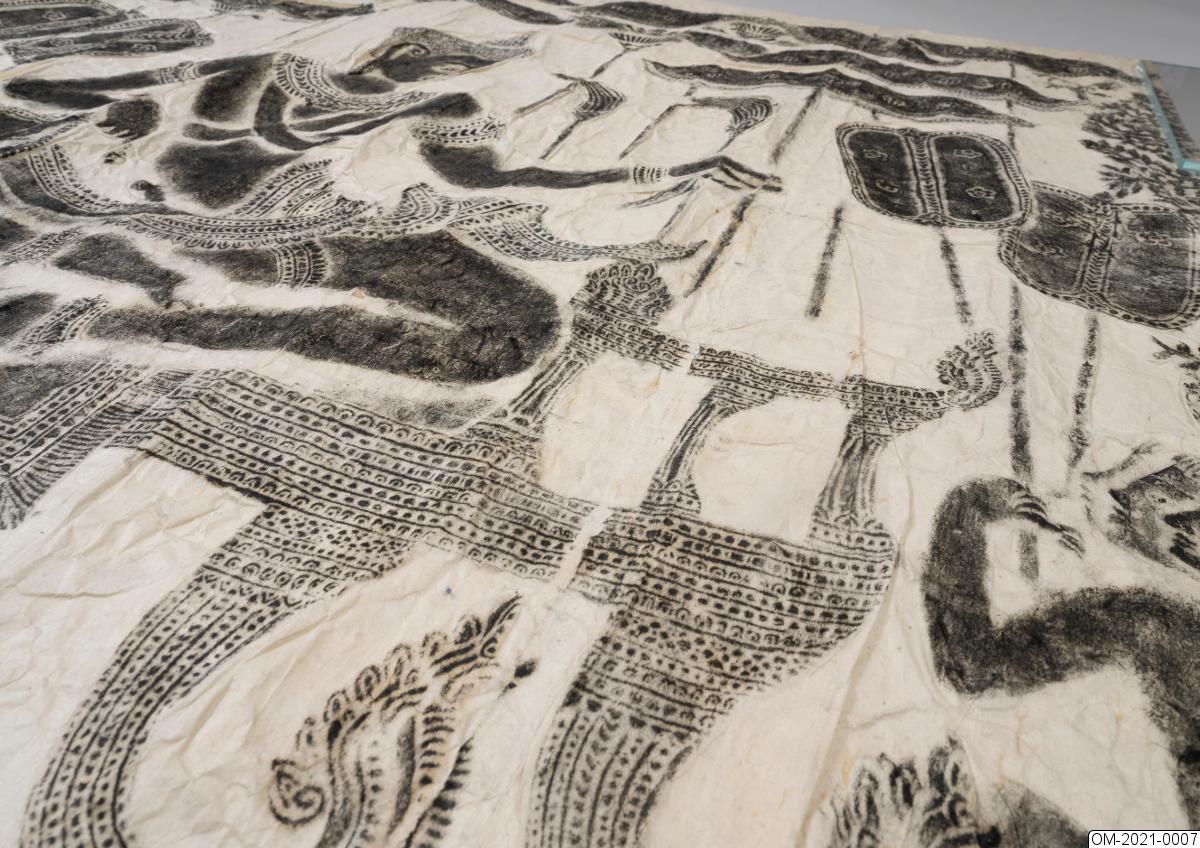
Avklappningens centrala motiv överensstämmer med fotografiska avbildningar av reliefen i Angkor Vat, med kung Suryavarman II i denna scen, men vissa detaljer under och bakom tronstolen saknas i avklappningen.
Stäng
|
| Källor <itemDescription> |
-
George Coedès. 1963 [1947]. Angkor: An Introduction. Transl. E. Floyd Gardiner. Oxford University Press.
Albert le Bonheur. 1995. Of Gods, Kings, and Men: Bas-reliefs of Angkor Wat and Bayon. Serindia...
Visa hela
George Coedès. 1963 [1947]. Angkor: An Introduction. Transl. E. Floyd Gardiner. Oxford University Press.
Albert le Bonheur. 1995. Of Gods, Kings, and Men: Bas-reliefs of Angkor Wat and Bayon. Serindia Publications. London, sid. 20–21, 30.
Stäng
|
| Förvärvsomständigheter <itemDescription> |
|
| Anmärkning <itemDescription> |
|
| Land, engelska / ursprung <itemDescription> |
|
| Beskrivning, engelska <itemDescription> |
-
Rubbing from Angkor Wat
The rubbing dates to the 1960s.
The motif here is King Suryavarman II (ca. 1095 - ca. 1150, regent 1113 - ca. 1150) who sits on a throne on Mount Sivapada (Siva's footprint) to...
Visa hela
Rubbing from Angkor Wat
The rubbing dates to the 1960s.
The motif here is King Suryavarman II (ca. 1095 - ca. 1150, regent 1113 - ca. 1150) who sits on a throne on Mount Sivapada (Siva's footprint) to receive the troops' tribute. The king's high position is shown, among other things, by the royal headdress, the throne and the many parasols, fans and fly whisks that surround him and by the fact that he is made larger than the surrounding people. The motif forms the beginning of what has been called "The Historical Procession".
The original of the "Historical Procession" is a sandstone relief in the temple of Angkor Wat located in the western part of the southern outer gallery. The total length of the relief panel is almost 100 m. The motif of King Suryavarman II on Mount Sivapada is seen at the start of the procession and he is depicted again in the centre of the procession where each previous and subsequent unit is led by a high representative of provinces in the kingdom. The relief probably dates to the middle of the 12th century some time after the king's death. An inscription with descriptive text runs under the relief.
Angkor Wat is the mausoleum of King Suryavarman II and the king initiated the construction during his reign in the first half of the 12th century. The temple was dedicated to the god Vishnu, a deity the king was considered to be a manifestation of and to have joined with at his death and was therefore also a temple for the worship of the king. In the inscription, the king is named Paramavisnuloka (He who reached the kingdom of the Supreme Vishnu).
The rubbing corresponds with photographic depictions of the relief in Angkor Wat, with King Suryavarman II in this scene, but some details below and behind the throne are missing in the rubbing.
Stäng
|
| Referens, källa <itemDescription> |
|
| Referens, källa <itemDescription> |
-
LeBonheur, Albert. & Poncar, Jaroslav. (red.) (1995). Of gods, kings, and men: bas-reliefs of Angkor Wat and Bayon. London: Serindia Publ.
|
| Händelse <context> |
-
Ursprung i Kambodja, Asien.
-
Insamlad 1967 .
-
Förvärvad 2010 av Myrdal, Jan.
|
| Material, engelska<itemMaterial> |
- paper
|
| Material<itemMaterial> |
- papper
|
| Nyckelord <itemKeyWord> |
-
paper
-
rubbing
-
Angkor Wat
-
OM-2021-0007
-
Sydostasien
-
paper
-
종이 紙
|
| Motiv <itemMotiveWord> |
|
| Sakord<itemName> |
- avklappning
|
| Ämne <subject> |
|
| Accessionsnummer <itemNumber> |
|
| Rättigheter för metadata <itemLicense> |

|
| Källa <presOrganization> |
Statens museer för världskultur - Östasiatiska museet |
|
Källa <url>
|
|






 ARTIKLAR I WIKIPEDIA
 ARTIKLAR I WIKIDATA
 BILDER I WIKIMEDIA COMMONS