| Typ <itemType> |
Objekt/föremål |
| Datering <presTimeLabel> |
Roman |
| Plats <presPlaceLabel> |
Afrika, Egypten, Fayum 1889. |
| Description <itemDescription> |
-
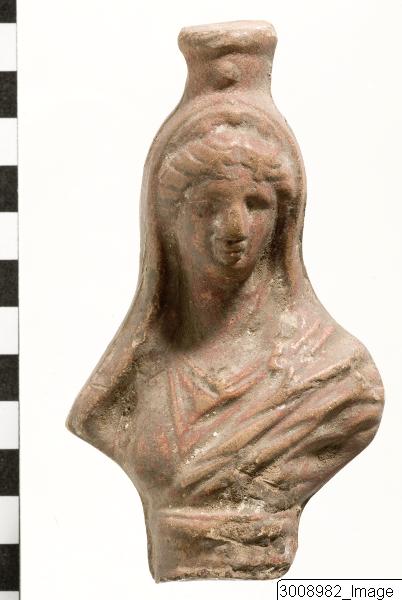
Figurine, bust of Isis or Demeter. Moulded. The goddess is wearing a polos and has her head covered by a veil which falls down over her shoulders. Her hair is wavy and combed towards the neck. Wide, flat nose, full lips. and is wearing a tall headdress.
|
| Inventory number <itemDescription> |
|
| Acquisition <itemDescription> |
|
| Comments <itemDescription> |
-
Object marked: Fayum 1889.
Äldre bild Cecilia Hennix 1998.
|
| Condition <itemDescription> |
|
| Cf Publications <itemDescription> |
-
Craindor, P., Terres cuites de de l’Égypte gréco-romaine, Antwerp 1939, pl. X1:29
Wijngaarden, De Grieks-egyptische terracotta’s in het Rijksmuseum van Oudheden, Oudhedkundige Mededelingen Suppl. N.R....
Visa hela
Craindor, P., Terres cuites de de l’Égypte gréco-romaine, Antwerp 1939, pl. X1:29
Wijngaarden, De Grieks-egyptische terracotta’s in het Rijksmuseum van Oudheden, Oudhedkundige Mededelingen Suppl. N.R. XXXIX, Leiden 1958, pl. 1:6
Ancient Egypt, 1916, 49
Stäng
|
| Period, Swedish <itemDescription> |
|
| Source / http <itemDescription> |
|
| Country / Findspot <itemDescription> |
|
| Exhibition / Planned <itemDescription> |
|
| Acquisition, Swedish <itemDescription> |
|
| Exhibition, showcase / Planned <itemDescription> |
|
| Antika mysterier, text sv <itemDescription> |
|
| Antika mysterier, text eng <itemDescription> |
-
The word “initiate” (mystes) is never used in inscriptions to describe anyone associated with the cult of Isis, indicating an important difference between her cult and other mysteries. Men and women w...
Visa hela
The word “initiate” (mystes) is never used in inscriptions to describe anyone associated with the cult of Isis, indicating an important difference between her cult and other mysteries. Men and women who, for example, were initiated into the Eleusinian mysteries were not expected to maintain a continuing relationship with the sanctuary. In contrast, those initiated into the cult of Isis appear to have been expected to carry on serving the goddess. This indicates that initiation into the mysteries of Isis was modeled on an idea of Egyptian priesthood, who would typically live near the temples and fully commit their lives to their maintenance. At least in the second century CE, initiation appears to be a series of steps that lead to higher levels of service within the cult. Both in iconography and written sources the initiates of Isis are characterized by their shaved heads and linen robes. In the Metamorphoses, Apuleius describes how the linen robes for each level of initiation had different designs, with the robes of the first level being multicoloured and those of the second level being plain. The Metamorphoses further suggests a process whereby a series of initiations led some individuals up to higher ranks within the hierarchy of the cult. This terracotta figurine from Roman Egypt is likely a representation of either Isis or Demeter, veiled and wearing what appears to be a modius, possibly set with a star (in that case likely Sirius). The figurine highlights the similarities not only in function but also in depiction between the two goddesses. It was collected in the Fayum in 1889 by Gustaf Retzius and subsequently acquired by the Ethnographic Museum, from where it is on loan to the museum.
Stäng
|
| Händelse <context> |
-
Brukad Roman.
-
Funnen i Fayum 1889., Egypten, Afrika.
|
| Material, engelska<itemMaterial> |
- Clay
- Terracotta
- Pottery
|
| Material<itemMaterial> |
- Lera
- Terrakotta
- Keramik
|
| Nyckelord <itemKeyWord> |
-
Google Art 2019
-
Roman
-
ceramics
|
| Mått <itemMeasurement> |
-
Height / Höjd: 10,8 cm.
-
Width / Bredd: 6,5 cm.
|
| Object, Swedish<itemName> |
- figur
- figurin
|
| Object<itemName> |
- figurine
- figure
|
| Ämne <subject> |
|
| Inventory number <itemNumber> |
|
| Acquisition number <itemNumber> |
|
| Rättigheter för metadata <itemLicense> |

|
| Källa <presOrganization> |
Statens museer för världskultur - Medelhavsmuseet |
|
Källa <url>
|
|



 ARTIKLAR I WIKIPEDIA
 ARTIKLAR I WIKIDATA
 BILDER I WIKIMEDIA COMMONS