| Typ <itemType> |
Objekt/föremål |
| Plats <presPlaceLabel> |
Oceanien, Tonga |
| Beskrivning <itemDescription> |
|
| Anmärkning <itemDescription> |
-
In Tonga, decorated barkcloth is known as ngatu. Across the Pacific, such barkcloths are generally referred to as tapa, and before the introduction of European textiles they were used throughout the r...
Visa hela
In Tonga, decorated barkcloth is known as ngatu. Across the Pacific, such barkcloths are generally referred to as tapa, and before the introduction of European textiles they were used throughout the region for clothing and other everyday life functions, and ceremonial exchange. Today, ngatu remains an important symbol of wealth and prestige, still presented as gifts at weddings, funerals and chiefly investitures, and used in artistic performances.
The making of ngatu is traditionally women’s work, learned from an early age and usually carried out collectively. The cloth is made from the inner bark, or bast, of the paper mulberry tree (hiapo in Tongan, Broussonetia papyrifera in Latin). After the bast is stripped from the tree, it is soaked, then laid on a wooden anvil (tutua) and beaten with a mallet (ike), typically made from dense ironwood (toa). The rhythmic sound of many women beating bark together has often been described as the “heartbeat” of the islands. The resulting thin sheets, called feta‘aki, are joined using a natural paste made from starchy roots such as Polynesian arrowroot (mahoa‘a Tonga).
Once the large sheet is assembled, Tongan women decorate it with a combination of printing and painting. Designs are created using a kupesi, a patterned rubbing board bound to a slightly curved workbench. Natural dyes derived from local trees are used: koka (red cedar, Bischofia javanica), tongo (mangrove, Rhizophora mangle), and tuitui (candlenut tree, Aleurites moluccana). The bark is scraped, soaked and strained through hibiscus fibre to produce rich brown pigments. Women sit facing each other across the bench, rubbing the pigment over the cloth to transfer the motif. Once decorated, the ngatu is dried in the sun, sometimes weighted down with stones or coconuts, and then pressed flat by being placed under sleeping mats. Details are finally enhanced by hand-painting with tongo or tuitui dye, often using a sharpened pandanus fruit key as a brush.
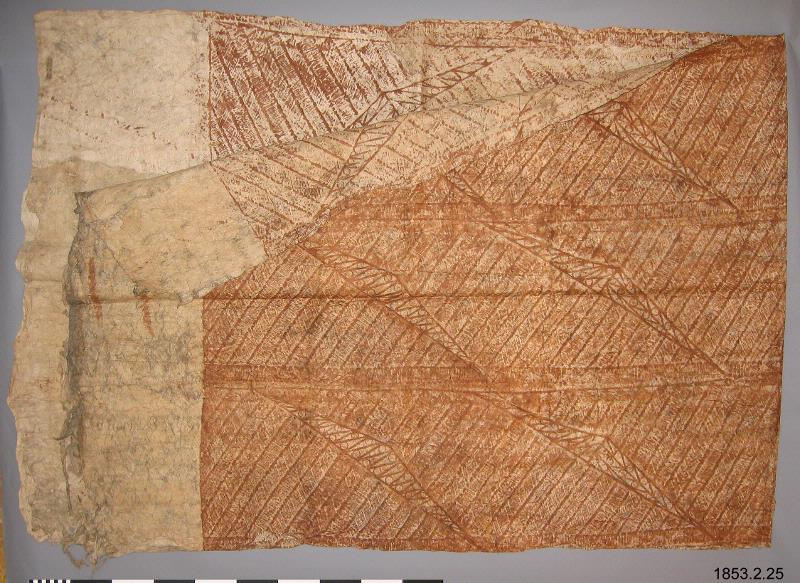
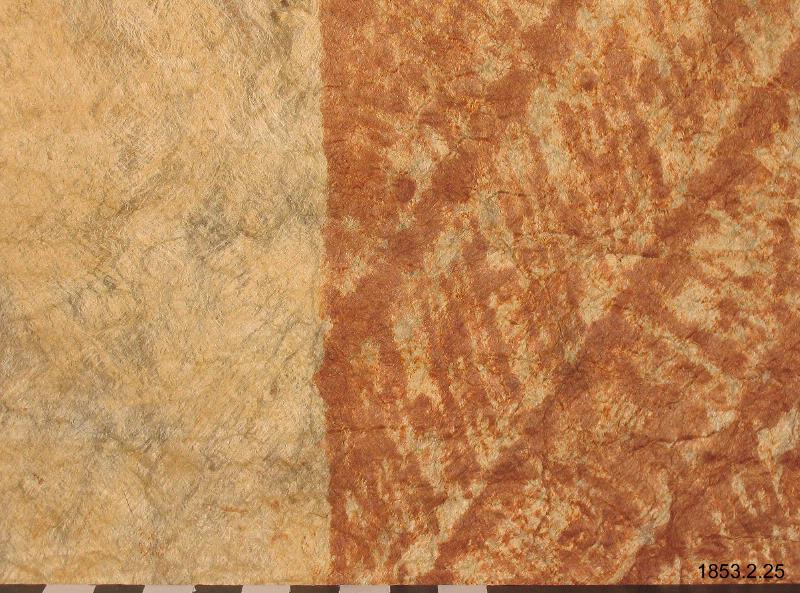
This type of barkcloth is known as ngatu tāhina, literally “white ngatu.” It is characterised by its white (natural) borders framing a central field of brown decoration. Brown is considered a beautiful and meaningful colour in Tonga, representing the land and complementing the blue of the sea and sky. This dualism between sea and land, and between men’s and women’s domains, is central to Tongan social organisation. Harmony and prosperity are believed to depend on the mutual support of siu tahi (men of the sea) and siu ‘uta (women of the land).
In the eighteenth and nineteenth centuries, patterns were mainly geometric and abstract, but later examples include more naturalistic or commemorative imagery. This barkcloth showcases matahihifi, an elongated triangle motif that first appeared on Tongan barkcloth in the mid-19th century. The motif is typically filled with intricate rubbed patterns; in this example, the triangles are adorned with zigzag lines interlocked with small circular motifs. (Héloise Dazard 2025).
Stäng
|
| Anmärkning <itemDescription> |
-
Provenance: Collected on 1 October 1852 by the Swedish frigate Eugenie during her circumnavigation voyage (1851–1853). The event is documented in the official account written by Premier-Lieutenant C...
Visa hela
Provenance: Collected on 1 October 1852 by the Swedish frigate Eugenie during her circumnavigation voyage (1851–1853). The event is documented in the official account written by Premier-Lieutenant Carl Skogman (1820–1907), who was responsible for nautical and astronomical observations and was commissioned by the Royal Swedish Academy of Sciences to assist with the physical observations. According to Skogman’s published narrative (Fregatten Eugenies resa omkring jorden åren 1851–1853, Stockholm: A. Bonnier, 1854), the Eugenie was anchored off the island of Ha‘ano, in the Ha‘apai group (Tonga), near the channel between Foa and Lifuka. During the stay, the crew engaged in active trade with local inhabitants, exchanging foodstuffs and objects such as pigs, chickens, breadfruit, yams, bananas, fishing gear, spears, clubs, tapa, and various small curios (vol. 2, p. 31). Skogman further notes that European goods most prized by the islanders included cotton cloth, knives, axes, bottles, flasks, and glass beads. He also records a formal diplomatic exchange between the governor of Lifuka and one of the Eugenie’s officers, in which “a couple of quite beautiful tapa mats” were presented as friendship gifts (p. 32). It is presumed that this ngatu corresponds to one of those tapa mats given on that occasion. Donated to the museum in 1853 by Nils Ehrenfrid (Ehrenfried) Ekströmer (1826–1859), assistant surgeon aboard the frigate Eugenie. (Héloise Dazard 2025).
Stäng
|
| Källor <itemDescription> |
-
Veys, Fanny Wonu. Unwrapping Tongan Barkcloth: Encounters, Creativity and Female Agency. London: Bloomsbury Academic, 2017.
|
| Källor <itemDescription> |
-
Lythberg, Billie. “Polyvocal Tongan barkcloths: contemporary ngatu and nomenclature at the Museum of New Zealand Te Papa Tongarewa”, Tuhinga, n°24, 2013, p.85-104.
|
| Källor <itemDescription> |
-
Kaeppler, Adrienne L. “West Polynesian Dyes and Decorations as Cultural Signatures” in Lennard, Frances & Mills, Andy. Material Approaches to Polynesian Barkcloth, Leiden: Sidestone Press, 2020, p.145...
Visa hela
Kaeppler, Adrienne L. “West Polynesian Dyes and Decorations as Cultural Signatures” in Lennard, Frances & Mills, Andy. Material Approaches to Polynesian Barkcloth, Leiden: Sidestone Press, 2020, p.145-155.
Stäng
|
| Källor <itemDescription> |
|
| Geografiskt namn / annat <itemDescription> |
|
| Geografiskt namn / annat <itemDescription> |
|
| Geografiskt namn / annat <itemDescription> |
|
| Geografiskt namn / annat <itemDescription> |
|
| Geografiskt namn / annat <itemDescription> |
|
| Geografiskt namn / annat <itemDescription> |
|
| Land / engelska <itemDescription> |
|
| Geografiskt namn / annat <itemDescription> |
|
| Geografiskt namn / annat <itemDescription> |
|
| Händelse / var närvarande vid <itemDescription> |
|
| Händelse / var närvarande vid <itemDescription> |
|
| Händelse <context> |
-
Ursprung i Tonga, Oceanien.
-
Förvärvad 1853 av Ekströmer, Nils Ehrenfrid.
|
| Material, engelska<itemMaterial> |
- plant fiber
|
| Materialkategori<itemMaterial> |
- växtmaterial
|
| Material<itemMaterial> |
- växtfiber
|
| Teknik <itemTechnique> |
|
| Nyckelord <itemKeyWord> |
|
| Mått <itemMeasurement> |
-
Höjd: 132 cm.
-
Bredd: 375 cm.
|
| Lokalt namn<itemName> |
- ngatu
|
| Sakord, engelska<itemName> |
- barkcloth
|
| Sakord<itemName> |
- barktyg
- tapa
|
| Ämne <subject> |
|
| Inventarienummer <itemNumber> |
|
| Rättigheter för metadata <itemLicense> |

|
| Källa <presOrganization> |
Statens museer för världskultur - Etnografiska museet |
|
Källa <url>
|
|

 ARTIKLAR I WIKIPEDIA
 ARTIKLAR I WIKIDATA
 BILDER I WIKIMEDIA COMMONS