| Typ <itemType> |
Objekt/föremål |
| Plats <presPlaceLabel> |
Asien, Kina |
| Beskrivning <itemDescription> |
-
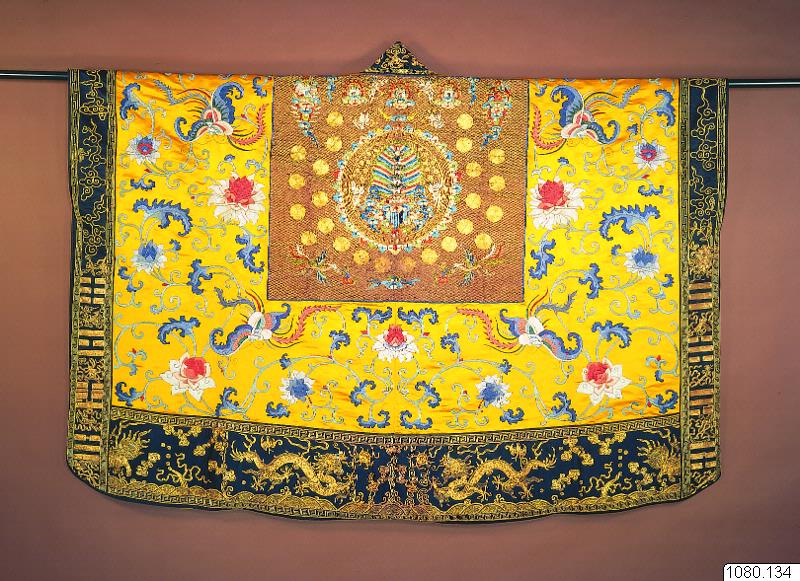
Taoistisk prästdräkt, flerfärgad, av sidensatin (det gula bottentyget) och tuskaft (gulgrönt sidenfoder), kantad med svarta satinband. Dräkten är rikligt dekorerad med bl. a. broderade tranor, femkloiga drakar, fladdermöss, pionrankor, andra blommor, arabesker och moln. På ryggen finns ett centralt brunt satinfält, en broderad (huvudsakligen plattsöm och metallan i läggsöm) rundel med bl. a. pagod...
Visa hela
Taoistisk prästdräkt, flerfärgad, av sidensatin (det gula bottentyget) och tuskaft (gulgrönt sidenfoder), kantad med svarta satinband. Dräkten är rikligt dekorerad med bl. a. broderade tranor, femkloiga drakar, fladdermöss, pionrankor, andra blommor, arabesker och moln. På ryggen finns ett centralt brunt satinfält, en broderad (huvudsakligen plattsöm och metallan i läggsöm) rundel med bl. a. pagod, tranor och fenixfåglar. På band vid kanterna finns trigrammönster. Dräkten knäpps med knutknapp och är "enkelt" kvadratiskt skuren på det typiska sättet för taoistiska prästdräkter, som t. ex. vanligen inte har egentliga ärmar. Sannolikt är Qing-dynastins taoistiska dräkter baserade på Ming-dynastins. Utmärkande för taoistiska dräkter är också det kosmiska diagrammet på ryggen, där pagoden symboliserar paradiset. (Jacobsen 1991, s. 19, fig. 16-18). Ytterligare tecken på det taoistiska ändamålet är trigrammen på bandkanterna. I Qing-dynastins stränga dräktskicksförordningar undantogs genom en oskriven regel ett antal grupper, speciellt sådana som ansågs vara av underordnad politisk betydlde. Till dessa hörde taoistiska (och buddhistiska) munkar. (Siggstedt 1995, s. 17). (PH) [[Etno]]
Stäng
|
| Beskrivning <itemDescription> |
-
Jacka i gul sidensatin, broderat blommönster i silke och guldmetalltråd,svarta satinbårder broderade med guldmetalltråd,fodrad med gulgrönt siden. [[Textil]]
|
| Publicerad text, engelska <itemDescription> |
-
Function: In the large Hedin collection belonging to the Museum of Ethnography, Stockholm, there are some robes, which in the archives are described as “lama robes”, i.e. intended for Buddhist priest...
Visa hela
Function: In the large Hedin collection belonging to the Museum of Ethnography, Stockholm, there are some robes, which in the archives are described as “lama robes”, i.e. intended for Buddhist priests in the Tibetan Buddhist tradition. It is probable that these are in fact Taoist priest robes. It is also possible that these robes were “annexed” into the Buddhist temples for their own use. The simple form of the Taoist robes and the fact that they are often lined with bass-fiber cloth incorporate the Taoist idea of the spiritual value in natural and rough materials. The ideal simplicity is a paradox since months of work is needed to make the garment. The pattern of the back piece is a cosmic diagram, where the pagoda symbolises the paradise. Each pattern has its own particular significance. Together they tell about the Taoist view of the Universe. Common Chinese symbols like dragons and cranes are also present. Sometimes Buddhist elements occur in the rich repertoire of symbols that this kind of robes draws upon. These priest robes are often called jiangyi, which can be translated as “red robe” or “the robe of descent”. It is one of two basic robe-models for Taoist purposes. Both of which have a history at least from the Song dynasty (960-1279). This model is still used. Continuity is thus one aspect on these clothes. Another is how robes can be used to express meanings, which can only be understood by those who are initiated in the context. Taoist robes are an example of how clothes can show mutual connection and community between those “who understand”. The robe is made of yellow silk-satin, richly embroidered with silk thread and paper gold, with an edging of black silk-satin ribbons and lined with tabby woven green silk cloth. The decorative elements of the garment can primarily be found on the back piece. It consists of cranes, butterflies, five-clawed dragons, bats, peony-vines and other flowers, arabesque patterns and clouds. Central motifs are a pagoda, cranes, phoenix-birds, gold dots (symbolising stars), the Sun with the three-legged bird and the Moon with the Moon Hare. There are trigram patterns on the black edging. The robe is buttoned with a knot button on the front.
Acquisition Acquired during Sven Hedin’s last expedition 1927-35, to be more precise on the 20th of January 1931 Export cleared by the Chinese authorities at the time.
Why this is a masterpiece
The present robe may serve as en example of the exquisite workmanship going into ceremonial costumes supplied to temples and monasteries during the Qing Dynasty. It also provides an idea of the wealth of motives and meanings that could be displayed on such garments.
History of the Object
The object was acquired in Beijing on the 20th of January 1931. Its earlier history is not known. Hedin’s ethnographer at that time, Gösta Montell, was mainly instrumental in bringing together the ethnographic collections. (Virtual Collection of Masterpieces, http://masterpieces.asemus.museum/Default.aspx)
Stäng
|
| Förvärvsomständigheter / i fält <itemDescription> |
|
| Land / engelska <itemDescription> |
|
| Händelse / var närvarande vid <itemDescription> |
|
| Händelse / var närvarande vid <itemDescription> |
|
| Händelse <context> |
-
Ursprung i Kina, Asien.
-
Insamlad 1929-12-17 .
-
Förvärvad 1931-01-20 av Hedin, Sven Anders.
|
| Material, engelska<itemMaterial> |
- silk
|
| Materialkategori<itemMaterial> |
- metall
- textil
|
| Material<itemMaterial> |
- silke
|
| Teknik <itemTechnique> |
-
broderat
-
handsytt [[Etno]]
-
satin
-
tuskaft
-
vävt [[Textil]]
|
| Nyckelord <itemKeyWord> |
-
1935.50.0166
-
Dräkt (290)
-
Dräkt (291)
-
H.0166
-
Kyrklig organisation (790)
-
Religiösa högtider och gudstjänster (796)
-
Sven Hedin
-
Textil, Skinn och Fibrer (280)
-
Textila tekniker (286)
-
kläder
-
klädesplagg
-
plagg
-
vcm
|
| Mått <itemMeasurement> |
-
Höjd: 130 cm.
-
Bredd: 192 cm.
|
| Sakord, engelska<itemName> |
- garb
- garment
- costume
|
| Sakord<itemName> |
- dräkt
- prästkåpa
|
| Ämne <subject> |
|
| Inventarienummer <itemNumber> |
|
| Tidigare identitet <itemNumber> |
|
| Rättigheter för metadata <itemLicense> |

|
| Källa <presOrganization> |
Statens museer för världskultur - Etnografiska museet |
|
Källa <url>
|
|

 ARTIKLAR I WIKIPEDIA
 ARTIKLAR I WIKIDATA
 BILDER I WIKIMEDIA COMMONS