| Text i dokument <itemDescription> |
-
Ainu The aboriginal people of Japan The Ainu people of Hokkaido once inhabited a much larger area than they do today. They were probably found on northern Honshu, and there were Ainus on southern Sakh...
Visa hela
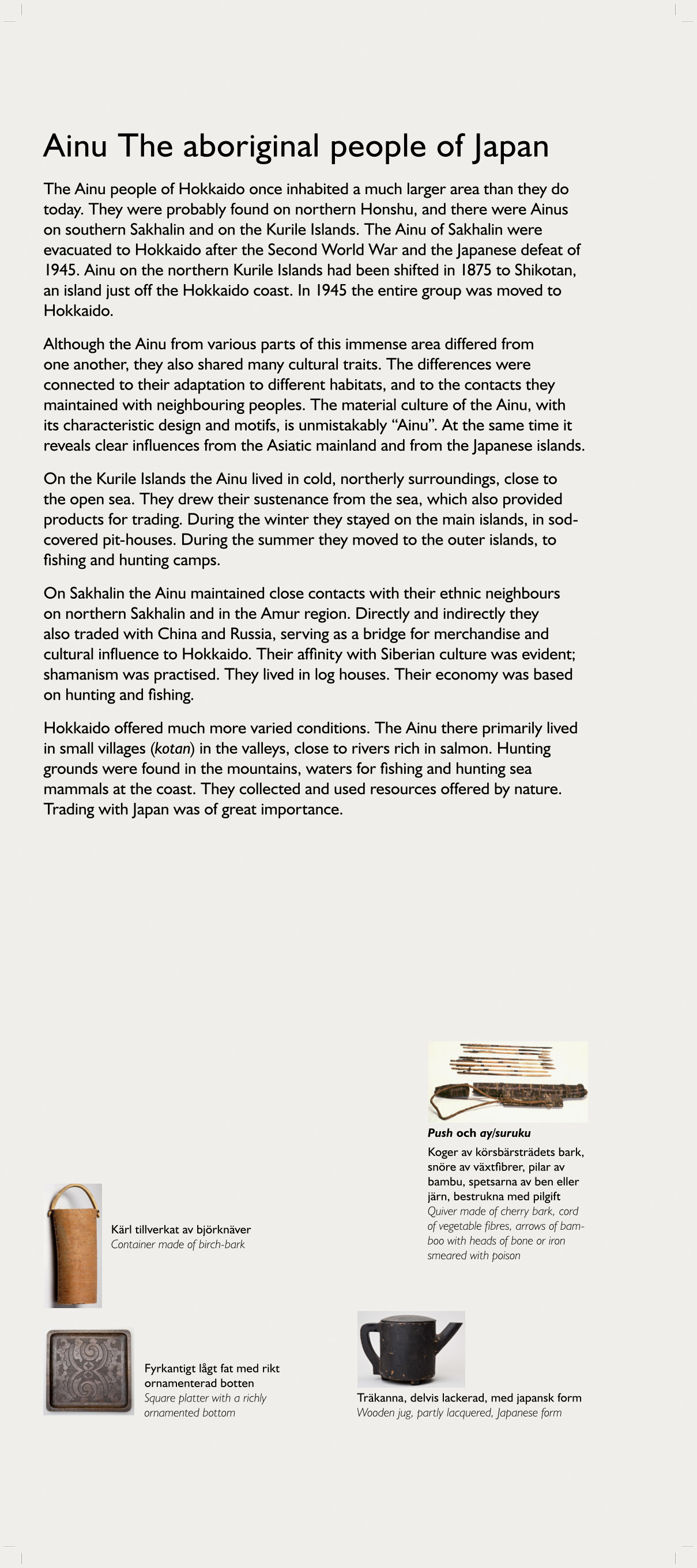
Ainu The aboriginal people of Japan The Ainu people of Hokkaido once inhabited a much larger area than they do today. They were probably found on northern Honshu, and there were Ainus on southern Sakhalin and on the Kurile Islands. The Ainu of Sakhalin were evacuated to Hokkaido after the Second World War and the Japanese defeat of 1945. Ainu on the northern Kurile Islands had been shifted in 1875 to Shikotan, an island just off the Hokkaido coast. In 1945 the entire group was moved to Hokkaido. Although the Ainu from various parts of this immense area differed from one another, they also shared many cultural traits. The differences were connected to their adaptation to different habitats, and to the contacts they maintained with neighbouring peoples. The material culture of the Ainu, with its characteristic design and motifs, is unmistakably “Ainu”. At the same time it reveals clear influences from the Asiatic mainland and from the Japanese islands. On the Kurile Islands the Ainu lived in cold, northerly surroundings, close to the open sea. They drew their sustenance from the sea, which also provided products for trading. During the winter they stayed on the main islands, in sod- covered pit-houses. During the summer they moved to the outer islands, to fishing and hunting camps. On Sakhalin the Ainu maintained close contacts with their ethnic neighbours on northern Sakhalin and in the Amur region. Directly and indirectly they also traded with China and Russia, serving as a bridge for merchandise and cultural influence to Hokkaido. Their affinity with Siberian culture was evident; shamanism was practised. They lived in log houses. Their economy was based on hunting and fishing. Hokkaido offered much more varied conditions. The Ainu there primarily lived in small villages (kotan) in the valleys, close to rivers rich in salmon. Hunting grounds were found in the mountains, waters for fishing and hunting sea mammals at the coast. They collected and used resources offered by nature. Trading with Japan was of great importance. Kärl tillverkat av björknäver Container made of birch-bark Push och ay/suruku Koger av körsbärsträdets bark, snöre av växtfibrer, pilar av bambu, spetsarna av ben eller järn, bestrukna med pilgift Quiver made of cherry bark, cord of vegetable fibres, arrows of bam- boo with heads of bone or iron smeared with poison Fyrkantigt lågt fat med rikt ornamenterad botten Square platter with a richly ornamented bottom Träkanna, delvis lackerad, med japansk form Wooden jug, partly lacquered, Japanese form
Stäng
|

 ARTIKLAR I WIKIPEDIA
 ARTIKLAR I WIKIDATA
 BILDER I WIKIMEDIA COMMONS