| Text i dokument <itemDescription> |
-
0622, 184, Mejkakudai, Dairen, 26, March 1928 då My dear ”r" Andersson, | I hope you have received my letter of the 24th Jan” in which I enclosed a letter to Prof. Kalgren. I am sorry that I have not ...
Visa hela
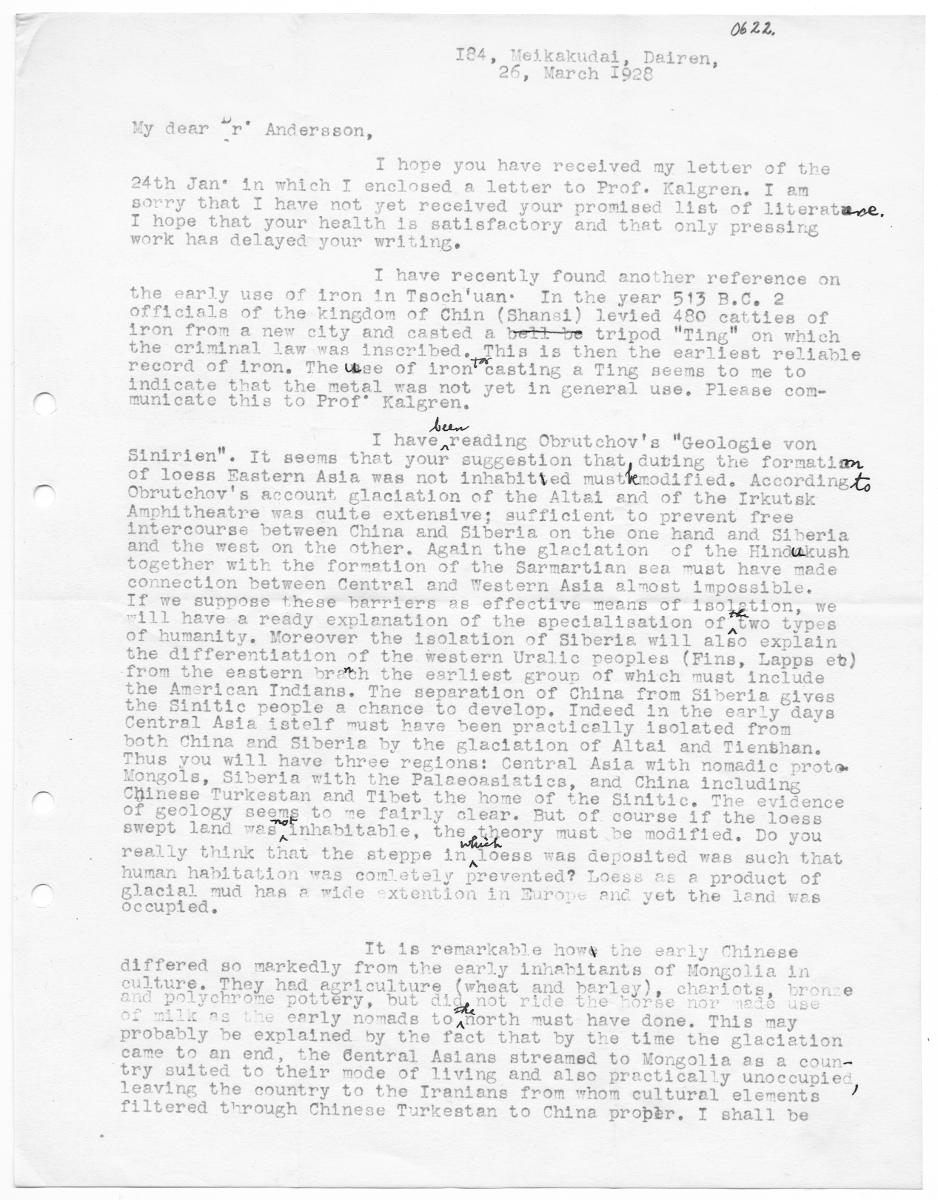
0622, 184, Mejkakudai, Dairen, 26, March 1928 då My dear ”r" Andersson, | I hope you have received my letter of the 24th Jan” in which I enclosed a letter to Prof. Kalgren. I am sorry that I have not yet received your promised list of literatae, I hope that your health is satisfactory and that only pressing : work has delayed your writing. I have recently found another reference on the early use of iron in Tsoch'uan: In the year 513 B.C, 2 officials of the kingdom of Öhin (Shansi) levied 480 cattiegs of iron from a new city and casted a bett-be tripod "Ting" on which the criminal law was inscribed., This is then the earliest reliable recorå of iron, The vkse of iron"'casting a Ting seems to me to indicate that the metal was not yet in general use, Please com- municate this to Prof" Kalgren, År i I have reading Obrutchov's "Geologie von Sinirien". It seems that your suggestion that, duting the formatimrw of loess Eastern Asia was not inhabitted mustkmodified,. According Obrutchov's account glaclation of the Altal and of the Irkutsk Amphitheatre was aulte extensive; sufficient to prevent free intercourse between China and Siberia on the one hand and Siberia and the west on the other. Again the gleciation of the Hindaekush together with the formation of the Sarmartian sea must have made connection between Central and Western Asia almost impossible. If we suppose these barriers as effective means of 180 Lion, we will have-a ready explanation of the speciallisatlon of two types of humanity. Moreover the isolation of Siberia will also explain the differentiation of the western Uralic peoples (Fins, Lapps et) from the eastern breth the earliest group of which must include the American Indians. The separation of China from Siberia glves the Sinitic people a chance to develop. Indeed in the early days Centrel Asia istelf must have been practicelly isolated from both China and Siberia by the glaciation of Altal and Tienbhan,. Thus you will have three regions: Central Asia with nomadic proto NMongols, Siberia with the Palaeoasiatics, and China including Chinese Turkestan and Tibet the home of the Sinitic. The evidence of geology seemg to me fairly clear. But of course 4f the l0ess swept land vas”inhabltable, the theory must be modified. Do you really think that the steppe in loess was deposited was such that human habitation was comletely prevented? Loess as a product of glacial mud has a wide extention in Europe and. yet the land was occupied, É It is remarkable how& the early Chinese differed so markedly from the early inhabitants of Mongolia in culture. They had agriculture (wheat and barley), cheariots, bronze and polychrome pottery, but did, not ride the horse nor nade use of milk as the early nomads tomorth must have done. This may probably be explained by the fact that by the time the glaciation came to an end, the Gentral Asians streamed to Mongolia as a coun- try suited to their mode of living and also practically unoccupied leaving the country to the Iranians from whom cultural elements filtered through Chinese Turkestan to China proper. I shall be
Stäng
|
| Text i dokument <itemDescription> |
-
RR SS a SR 0623, glad to have your criticism of this rough idea of a hypothesis. In the south India was the home of Protoaustralians who probably hed a very wide extention in prehistoric times, but di...
Visa hela
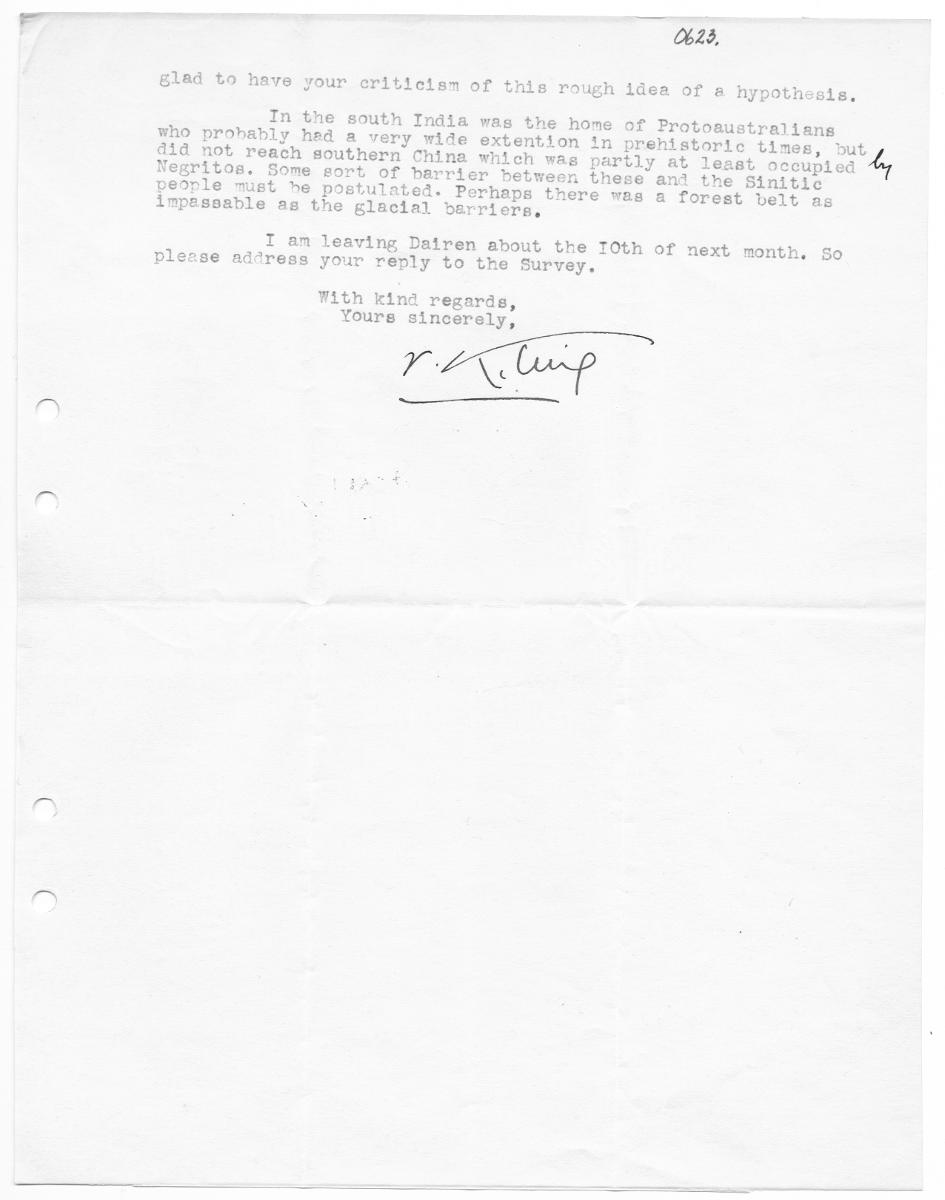
RR SS a SR 0623, glad to have your criticism of this rough idea of a hypothesis. In the south India was the home of Protoaustralians who probably hed a very wide extention in prehistoric times, but did not reach southern China which was partly at least Ooccuplied Negritos. Some sort of barrier between these anda the Sinitie people must he postulated. Perhaps there was a forest belt as impassable as the glacial barriers, I am leaving Dairen about the TOth of next month, So please addåress your reply to the Survey. With kina regards, Yours sincerely,
Stäng
|

 ARTIKLAR I WIKIPEDIA
 ARTIKLAR I WIKIDATA
 BILDER I WIKIMEDIA COMMONS