| Text i dokument <itemDescription> |
-
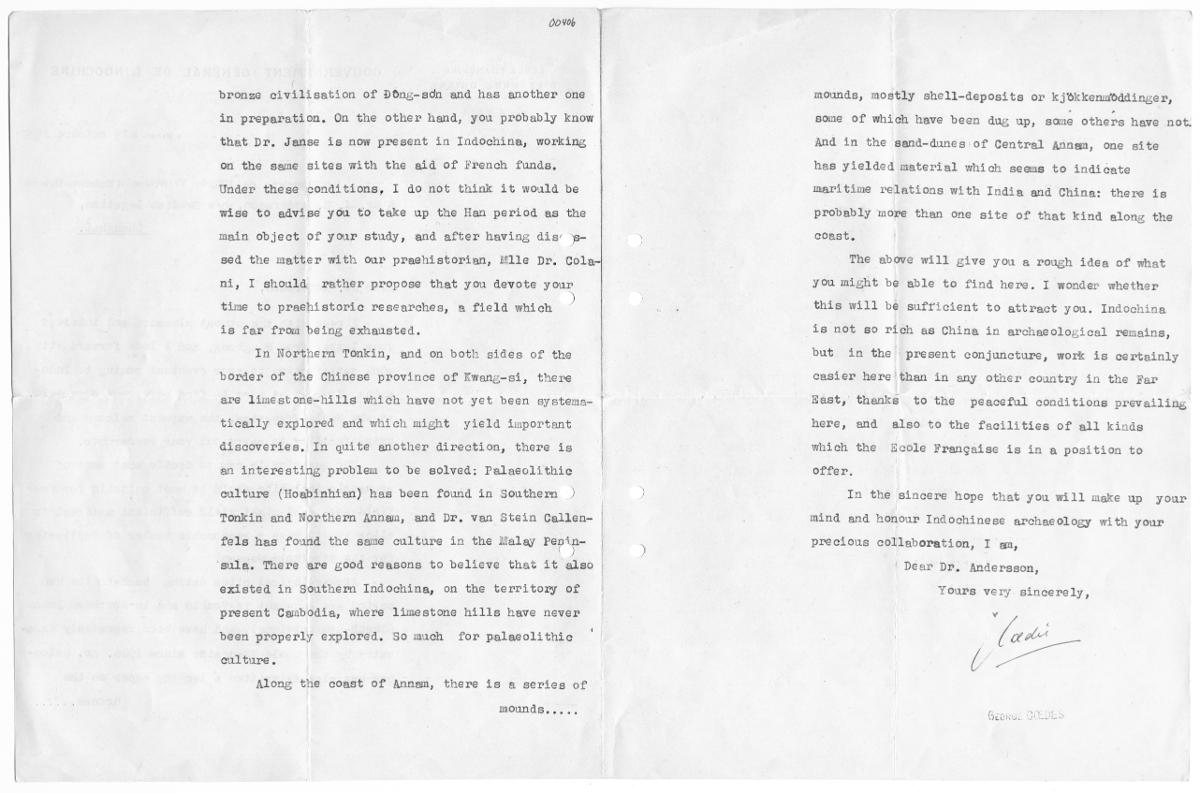
00986 bronse oivilisation of DOng-sdn and has another one ån preparation, On the other hand, you probably know that Dr. Janse is now present in Indochine, working on the sane sites with the aid of French fande, Under these conditions, I do not think it woald be wise to säviss you to take up the Han period as the maln object of your study, and after having dis: g sed the matter with our praehistori...
Visa hela
00986 bronse oivilisation of DOng-sdn and has another one ån preparation, On the other hand, you probably know that Dr. Janse is now present in Indochine, working on the sane sites with the aid of French fande, Under these conditions, I do not think it woald be wise to säviss you to take up the Han period as the maln object of your study, and after having dis: g sed the matter with our praehistorimn, Mlle Dr. Cola-| ni, I shoald rather propose that you devote yoar tine to praehistorie researches, s field which | 18 for frön being exhansted. In Northern Tonkin, and on both sides of the border of the Chinese province of Kwang-ei, there are limestone-hills wiich have not yet been systema- | tically explored and which might yield inportant disooverien. In quite another direction, there is en interesting problem to be solved: Palacolithie oalture (Hosbinhian) has been found in Soathem ) Tonkin and Northern Annan, and Dr, ven Stein Cellen- fela has foand the sase cultare in the Malay Pepta- sila. There are good roacons to believe that it also existed in Southern Indochina, on the territory of present Cawodla, where limostone hills have never been properly explored, 30 mich for palasolithto enltare, Along the coast of Annam, there is a sori moandg, mounda, mostly shell-deposite or kjökkensbddinger, o0ae of Which have been dug up, sane others have not. And in the sand-dunes of Central AMinsn, one site has yielded material which secs to indicate maritine relations with India and Chin: there 16 probably more than one site of that kind along the ovat. The ebove will give you a rough idea of what yoa might be eble to find hero. I wonder whether this wtll be sufficient to attract you. Indochina £e not so rich as China in arckeeologicel remains, bat in the present conjuneture, work is certeinly oasier here than in any other eoantry in the Far ast, thanks to the peaceful conditions prevalling here, and also to the facilities of all kinde which the Ecole Frengaisc is in a position to offer. In the sincere hope that you will meke up your mind and honor Indochinese archecology with your precious collsboration, I an, Dear Dr. Andersson, RE ai RR
Stäng
|
| Text i dokument <itemDescription> |
-
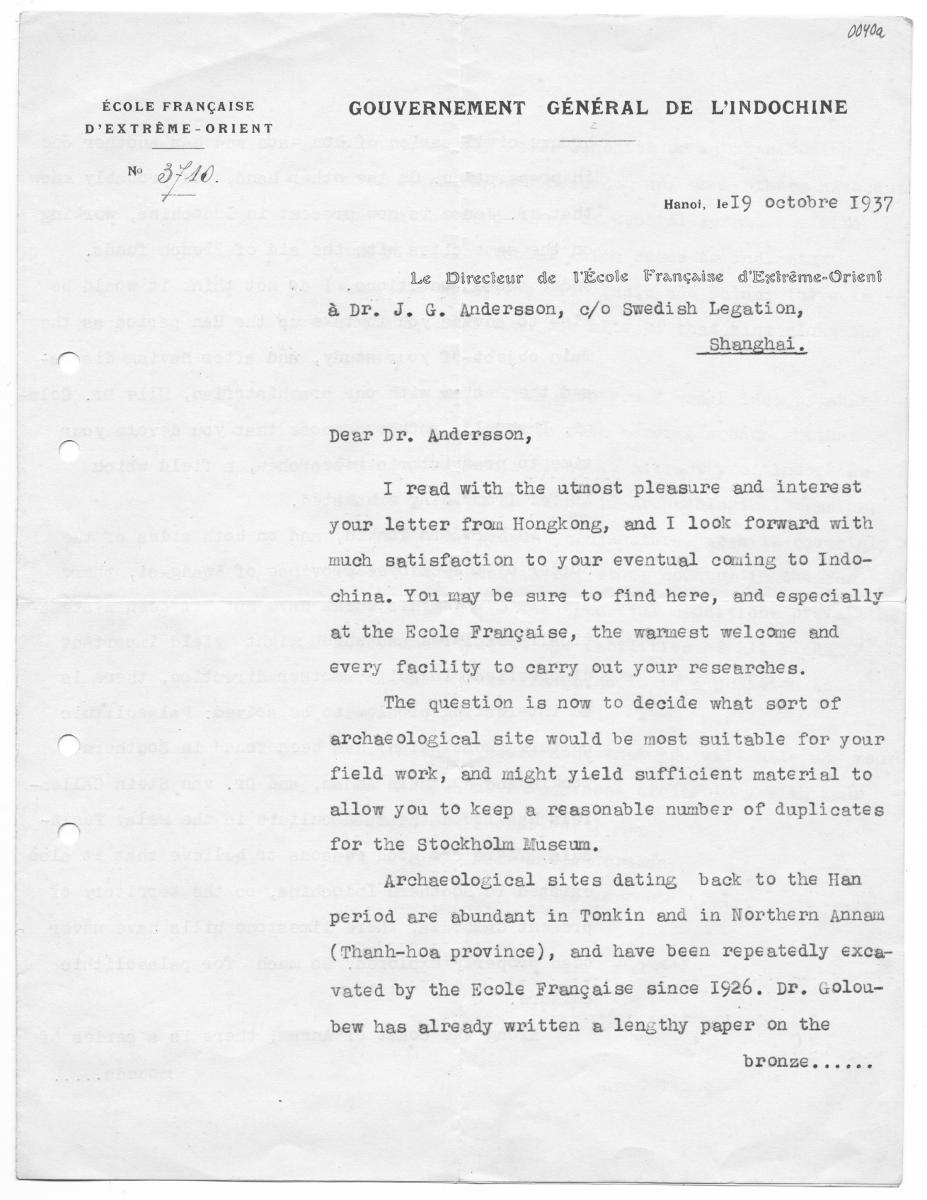
0010 ÉCOLE FRANGAISE GOUVERNEMENT GÉNÉRAL DE L'INDOCHINE D'EXTRÉME-ORIENT Hanol, 1eI9 octobre 1937 ; Le Direcieur de VÉcole Frangaise d'Egtreme-Orient å Dr. J, G. Andersson, c/o Swedish Legation, Deer...
Visa hela
0010 ÉCOLE FRANGAISE GOUVERNEMENT GÉNÉRAL DE L'INDOCHINE D'EXTRÉME-ORIENT Hanol, 1eI9 octobre 1937 ; Le Direcieur de VÉcole Frangaise d'Egtreme-Orient å Dr. J, G. Andersson, c/o Swedish Legation, Deer Dr. Andersson, I read with the utmost pleasure and interest your letter fron Hongkong, and I look forward with much satisfaction to your eventual coming to Indo- china. You may be sure to find here, and especially at the Ecole Frangaise, the warmest welcome and every facility to carry out your reseerches. The question is now to decide what sort of archae ological site would be most suitable for your field work, and might yield sufficient material to allow you to keep a reasonable number of duplicates for the Stockholm Museum, Archaeological sites dating back to the Han period are abundant in Tonkin and in Northern Annam (Thanh-hoa province), and have been repeatedly exca- vated by the Ecole Frangaise since 1926. Dr. Golou- bew has already written a lengthy paper on the bronze,....«
Stäng
|

 ARTIKLAR I WIKIPEDIA
 ARTIKLAR I WIKIDATA
 BILDER I WIKIMEDIA COMMONS