| Typ <itemType> |
Objekt/föremål |
| Datering <presTimeLabel> |
New Kingdom, 18th Dynasty (1569-1315 BC) [mid] |
| Plats <presPlaceLabel> |
Afrika, Egypten, Luxor [?] |
| Description <itemDescription> |
-
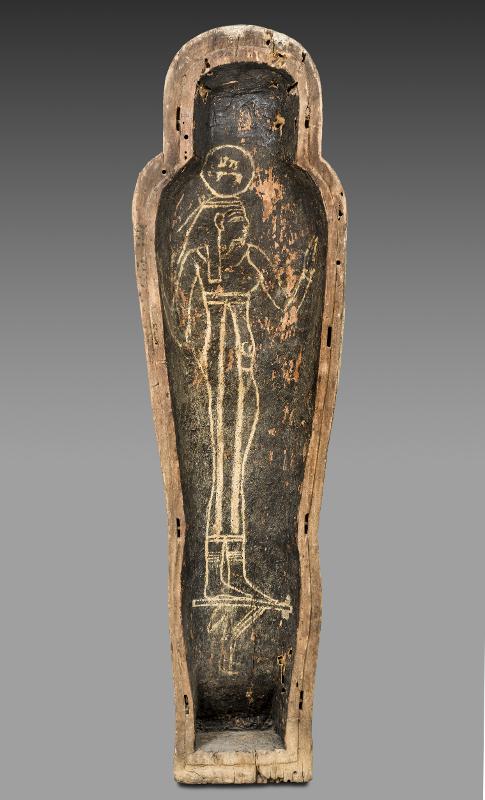
Painted image of the Goddess Nut on the inside of the lid. She is standing on an elevated standard with her hands raised.
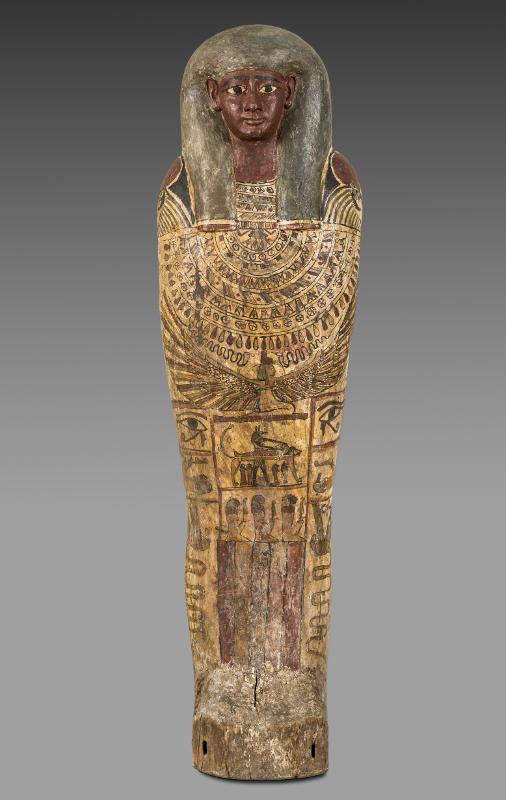
The lid of an anthropoid coffin, wearing a tripartite wig, with no hands and decorated in polychrome. The face is painted red, the wig green, with yellow and red banded terminals. A very deep broad collar reaches from below the shoulders to just below the waist, springing from ...
Visa hela
Painted image of the Goddess Nut on the inside of the lid. She is standing on an elevated standard with her hands raised.
The lid of an anthropoid coffin, wearing a tripartite wig, with no hands and decorated in polychrome. The face is painted red, the wig green, with yellow and red banded terminals. A very deep broad collar reaches from below the shoulders to just below the waist, springing from a pair of very large raptor-form terminals. Below this is a keeling figure of Isis, facing left, with wings extending upwards towards the edge of the lid. Below are three registers, respectively containing:
Anubis bending over the mummy; three squatting deities; five vertical bands, reaching from the knees to the ankles. The upper register is flanked by a pair of wadjet-eyes, below each of which is, at 90 degrees, a squatting deity (ape-headed on the left, human-headed on the right) and a winged cobra, its body stretching down to the ankles.
The feet have been extensively re-worked to change them from the form current during the New Kingdom, to the pedestalled form that first appears under Takelot III and continues into Roman times. Tenon-sockets indicate that the outer parts of the feet were provided in separate pieces.
The interior is painted black, with a figure of the goddess Nut in yellow outline, facing left, with a solar disk containing her name on her head.
Stäng
|
| Inventory number <itemDescription> |
|
| Acquisition <itemDescription> |
|
| Comments <itemDescription> |
-
The form of the face and headdress, plus the proportions of the whole piece, and the colouration of the interior and the figure of Nut, make it clear that it was originally manufactured during the mid...
Visa hela
The form of the face and headdress, plus the proportions of the whole piece, and the colouration of the interior and the figure of Nut, make it clear that it was originally manufactured during the middle of the Eighteenth Dynasty, and was originally a ‘black’ coffin of the type introduced under Thutmose III. However, the decoration of the outside is typical of the Ptolemaic Period, as is the adapted form of the foot. Accordingly, the piece must have been recovered from a robbed tomb and adapted for a new owner a thousand years after its original manufacture. (Dodson)
Stäng
|
| Comments <itemDescription> |
|
| Comments <itemDescription> |
|
| Comments <itemDescription> |
|
| Comments <itemDescription> |
|
| Dimensions <itemDescription> |
|
| Period, Swedish <itemDescription> |
|
| Publications <itemDescription> |
|
| Utställning / ingår i <itemDescription> |
|
| Exhibition / Previously <itemDescription> |
|
| Country / Findspot <itemDescription> |
|
| Exhibition, Part of / Current <itemDescription> |
|
| Exhibition, Part of / Previously <itemDescription> |
|
| Description, Swedish <itemDescription> |
|
| Description, Swedish <itemDescription> |
|
| Description, Swedish <itemDescription> |
-
Målad bild av gudinnan Nut på insidan av locket. Hon står på ett upphöjt standar med hennes händer upphöjda.
Locket av en antropoid kista som bär en tredelad peruk, är utan händer och dekorerat i mång...
Visa hela
Målad bild av gudinnan Nut på insidan av locket. Hon står på ett upphöjt standar med hennes händer upphöjda.
Locket av en antropoid kista som bär en tredelad peruk, är utan händer och dekorerat i många färger. Ansiktet är målat i rött, peruken grön med gula och röda, bandade, avslutningar. En mycket djup, bred krage når från nedanför axlarna till strax under midjan och som löper från ett par mycket stora rovfågelformade avslutningar. Nedanför denna finns en knäböjande figur av Isis, vänd åt vänster, med vingar som breder ut sig uppåt mot kanten av locket. Nedanför finns tre register som innehåller följande:
Anubis som böjer sig över mumien, tre hukande gudomar, fem vertikala band som når från knäna till anklarna.
Det övre registret är flankerat med ett par wadjet-ögon, nedanför vilka finns, i 90 graders vinkel, en hukande gudom (aphövdad till vänster, människohövdad till höger) och en bevingad kobra vars kropp sträcker sig ner mot anklarna.
Fötterna har blivit kraftigt omarbetade för att förändra dem från den form som rådde under Nya riket till en piedestal-form som uppträder först under Takelot III och fortsätter in i Romersk tid. Tappar och uttag indikerar att den yttre delen av fötterna kom i separata delar.
Insidan är målad svart med en figur av gudinnan Nut i gul kontur, vänd åt vänster, med en solskiva som innehåller hennes namn på huvudet.
Stäng
|
| Acquisition, Swedish <itemDescription> |
|
| Geographic name, alternative <itemDescription> |
|
| Geographic name, alternative / Swedish <itemDescription> |
|
| Referens, publicerad i <itemDescription> |
|
| Exhibition, showcase / Current <itemDescription> |
|
| Egyptenutställningen 2014, English / Label <itemDescription> |
-
Coffin lid with outer decorations that are typical of the Ptolemaic Period. But the shape and the decoration on the inside of the lid show that it was made already during the 18th dynasty. It shows th...
Visa hela
Coffin lid with outer decorations that are typical of the Ptolemaic Period. But the shape and the decoration on the inside of the lid show that it was made already during the 18th dynasty. It shows that someone during the Ptolemaic Period reused a coffin that was already then over a thousand years old. He or she has only repainted it according to the time’s fashion.
Stäng
|
| Egyptenutställningen 2014, Swedish / Label <itemDescription> |
-
Kistlock som på utsidan ser typiskt ptolemeiskt ut. Men lockets form och framför allt dekoren på dess insida avslöjar att det tillverkades redan under den 18:e dynastin. Det innebär att någon i ptolem...
Visa hela
Kistlock som på utsidan ser typiskt ptolemeiskt ut. Men lockets form och framför allt dekoren på dess insida avslöjar att det tillverkades redan under den 18:e dynastin. Det innebär att någon i ptolemeisk tid har återanvänt en kista som redan då var över tusen år gammal. Han eller hon lät bara måla om den enligt tidens mode.
Stäng
|
| Händelse <context> |
-
Förvärvad av Clarholm, Per, Clarholm, Mrs.
-
Brukad New Kingdom, 18th Dynasty (1569-1315 BC) [mid].
-
Funnen i Luxor [?], Egypten, Afrika.
|
| Material, engelska<itemMaterial> |
- Wood, stuccoed and painted
|
| Material<itemMaterial> |
- Trä, stuckad och målat
|
| Nyckelord <itemKeyWord> |
-
E. 3940
-
New Egypt
-
New Kingdom, 18th Dynasty (1569-1315 BC) [mid]
|
| Mått <itemMeasurement> |
-
Height / Höjd: 198,5 cm.
-
Height / Höjd: 7 cm. face
-
Length / Längd: 198,5 cm.
-
Depth / Djup: 20 cm.
-
Width / Bredd: 54,5 cm.
|
| Object, Swedish<itemName> |
- lock
- kista
|
| Object<itemName> |
- coffin
- lid
|
| Ämne <subject> |
|
| Inventory number <itemNumber> |
|
| Previous ID <itemNumber> |
|
| Egypt, Number in Exhibition <itemNumber> |
|
| Rättigheter för metadata <itemLicense> |

|
| Källa <presOrganization> |
Statens museer för världskultur - Medelhavsmuseet |
|
Källa <url>
|
|



 ARTIKLAR I WIKIPEDIA
 ARTIKLAR I WIKIDATA
 BILDER I WIKIMEDIA COMMONS