| Typ <itemType> |
Objekt/föremål |
| Datering <presTimeLabel> |
Joseon (1392-1897) |
| Plats <presPlaceLabel> |
Sydkorea, Nordkorea |
| Beskrivning <itemDescription> |
-
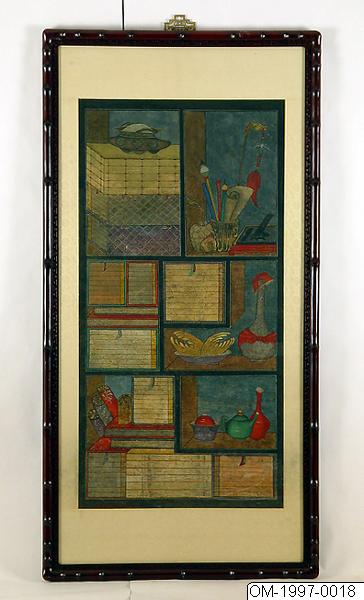
Den här målningen i färger på papper föreställer en bokhylla med travar av böcker, kontorsmaterial och dekorativa föremål som man kunde hitta i en konfuciansk lärd mans arbetsrum under Joseon (1392-1910). Högst upp till vänster syns en hyllsektion med en trave böcker och bredvid den en hylla med olika skriv- och måleriverktyg, som en penselburk med penslar och pennor, en persikoformad vattendroppa...
Visa hela
Den här målningen i färger på papper föreställer en bokhylla med travar av böcker, kontorsmaterial och dekorativa föremål som man kunde hitta i en konfuciansk lärd mans arbetsrum under Joseon (1392-1910). Högst upp till vänster syns en hyllsektion med en trave böcker och bredvid den en hylla med olika skriv- och måleriverktyg, som en penselburk med penslar och pennor, en persikoformad vattendroppare och en tuschstång och rivsten till tusch. På de mellersta hyllorna syns två stycken "Buddhas hand" (bulsugam på koreanska - en slags citron som symboliserar lycka och långt liv) bredvid en vinflaska och en kopp, och de tillsammans med en trave böcker. Längst ner syns en keramikskål, en karaff och en flaska, samt, i en annan sektion: böcker och rullar med målningar.) Värt att notera är användningen av linjeperspektiv och skuggning. Stilleben där motivet utgörs av böcker och andra föremål som fanns i lärda mäns arbetsrum kallas för Chaekgeorido- eller Chaekgadomålning. De första chaekgeoridomålningarna i Korea målades vid kung Jeongjos hov (r. 1776-1800) under det sena 1700-talet. I dessa målningar avbildades stora bokhyllor som var nästan helt och hållet fyllda med böcker, för att inspirera till akademiska studier och kunskapssträvan i samhället. Snart blev chaekgeorimålningar populära även utanför hovet och de spreds under 1800-talet vidare till andra samhällsklasser. Det fanns ett stort intresse hos de förmögna över- och medelklasserna för antikviteter och dekorativa skrivutensiler och de uppskattade att få dem avbildade i chaekgeoridomålningar.
Medan de tidigare chaekgeoridomålningarna föreställer stora bokhyllor med böcker på det sätt som syns här på vikskärmen, så uteslöts ofta hyllorna i senare målningar och böckerna målades i staplar omgivna av olika samlarföremål, skrivutensiler och allmänt dekorativa föremål, samt frukter, blommor och lyckobringande grönsaker (se chaekgeoridomålningar OM-1987-0072).
Stäng
|
| Källor <itemDescription> |
-
National Research Institute of Cultural Heritage. 2016. Korean Collections at the British Museum (영국박물관 소장 한국문화재), Catalogue of Overseas Korean Cultural Heritage No. 34. Seoul: National Research Insti...
Visa hela
National Research Institute of Cultural Heritage. 2016. Korean Collections at the British Museum (영국박물관 소장 한국문화재), Catalogue of Overseas Korean Cultural Heritage No. 34. Seoul: National Research Institute of Cultural Heritage, 167.
책거리. 2017. 책거리. [ONLINE] Available at: http://terms.naver.com/entry.nhn?docId=3561742&cid=58721&categoryId=58726. [Accessed 04 December 2017].
책가도. 2017. 책가도. [ONLINE] Available at: http://terms.naver.com/entry.nhn?docId=1201878&cid=40942&categoryId=33052. [Accessed 13 October 2017].
The Metropolitan Museum of Art, i.e. The Met Museum. 2017. Unidentified Artist | Books and Scholars' Possessions | Korea | The Met. [ONLINE] Available at: https://www.metmuseum.org/art/collection/search/73134?sortBy=Relevance&ft=chaekgeori&offset=0&rpp=20&pos=1. [Accessed 15 October 2017].
Yoon, Y., Whitfield, R. (ed.), Nam, W. (trans.). 2002. Folk Painting. Seoul: Yekyong Publishing.
Stäng
|
| Förvärvsomständigheter <itemDescription> |
|
| Anmärkning <itemDescription> |
|
| Utställning, del av / planerad <itemDescription> |
|
| Utställning / planerad <itemDescription> |
|
| Land, engelska / ursprung <itemDescription> |
|
| Land, engelska / ursprung <itemDescription> |
|
| Beskrivning, engelska <itemDescription> |
-
This painting in colours on paper depicts a bookshelf filled with stacked books, stationary items and decorative objects that could be found in a study of a Confucian scholar of the Joseon dynasty (13...
Visa hela
This painting in colours on paper depicts a bookshelf filled with stacked books, stationary items and decorative objects that could be found in a study of a Confucian scholar of the Joseon dynasty (1392-1910). On the uppermost of the three levels, a variety of writing and painting utensils such as a brush pot with brushes and pens, a peach-shaped water dropper and an ink stick and ink stone, are depicted next to a compartment with stacked books. On the second level, there are two “Buddha's hand” (Korean: bulsugam - a kind of citron which symbolises longevity and happiness) alongside a wine bottle and a cup, also combined with stacks of books. On the lowest level, ceramic bowls, an ewer and a bottle are depicted next to a compartment with books and rolled paintings. Notable is the use of linear perspective and shading. The representation of books and other objects found in a scholar’s study in the manner of still life paintings is called Chaekgeorido or Chaekgado painting. In Korea, the first Chaekgeorido paintings were produced at the court of King Jeongjo (r. 1776–1800) in the late 18th century and depicted large bookshelves almost entirely filled with books to inspire academic study and the pursuit of knowledge in society. Soon Chaekgeorido also found appreciation among intellectuals outside of the court and further spread to the wider range of social classes during the 19th century. The wealthy upper and middle classes of that time had a keen interest in collecting antiquities and decorative scholarly items for their studies and enjoyed having them portrayed alongside neatly stacked books and displayed in their studies. This later type of Chaeokgeorido were sometimes depicted with bookshelves, as can be seen in this example, and sometimes without, as in the paintings with the Accession No. OM-1987-0072.
Stäng
|
| Utställning, monterdel / planerad <itemDescription> |
|
| Utställning, monterdel / planerad <itemDescription> |
|
| Händelse / var närvarande vid <itemDescription> |
|
| Förvärvsomständigheter, engelska <itemDescription> |
-
Donated by the Axel and Nora Lundgren Foundation
Paul Champkins purchased this object through the Axel and Nora Lundgren Foundation in London for £4.000.
|
| Sakord, korea <itemDescription> |
|
| Beskrivning, Korea <itemDescription> |
-
조선시대 선비의 서재를 꾸민 책을 가득 쌓은 책꽂이, 문방구 및 장식품들을 종이에 채색하여 묘사한 그림이다. 세 칸 중 맨 위 오른쪽 칸에는 붓을 꽂아둔 필통, 복숭아 모양의 연적, 먹, 벼루와 같은 다양한 종류의 문방구를 배치하고, 왼쪽 칸에는 책을 가지런히 쌓아 올렸다. 두 번째 칸에는 장수와 행복을 상징하는 과일인 불수감 두 개가 술잔으로 입구를 덮은...
Visa hela
조선시대 선비의 서재를 꾸민 책을 가득 쌓은 책꽂이, 문방구 및 장식품들을 종이에 채색하여 묘사한 그림이다. 세 칸 중 맨 위 오른쪽 칸에는 붓을 꽂아둔 필통, 복숭아 모양의 연적, 먹, 벼루와 같은 다양한 종류의 문방구를 배치하고, 왼쪽 칸에는 책을 가지런히 쌓아 올렸다. 두 번째 칸에는 장수와 행복을 상징하는 과일인 불수감 두 개가 술잔으로 입구를 덮은 술병 옆에 책더미와 함께 놓였다. 가장 아래 칸에는 자기 접시, 주전자, 병이 책꾸러미와 두루마리의 오른편으로 배치되었다. 선 원근법과 명암법의 사용이 뚜렷이 드러난다. 선비의 사랑방에서 사용하거나 그 공간을 장식한 책과 다른 기물들을 정물화의 형태로 묘사한 그림을 책거리 그림 혹은 책가도라고 부른다. 한국에서 최초의 책거리 그림은 정조 (재위: 1776~1800) 재위 시기인 18세기 후반에 제작되었는데, 책을 가득 채워 넣은 큰 책꽂이를 묘사하여 지식의 추구와 학문의 장려를 통한 정조의 문치(文治) 실현 의지를 표현한 것이라고 할 수 있다. 책거리 그림은 곧 궁궐 밖에서도 문인들이 선호하는 주제가 되었으며 19세기에는 민화의 소재로도 널리 유행했다. 이 시기 부유한 중상류계층은 서재를 꾸미기 위한 고동기물(古銅器物)과 각종 장식성이 강한 문방구류를 수집하고 감상하는 취미를 즐겼다. 따라서 이와 같은 진귀한 물건들을 쌓아 올린 책들 옆에 배치하여 그린 책거리 그림을 서재에 두고 실제처럼 연출하기도 한 것이다. 후기의 책거리 그림에는 본 박물관 소장의 이 유물의 예에서 보는 것처럼 책꽂이가 있는 경우와 유물번호 OM-1987-0072의 그림처럼 책꽂이가 없는 경우가 함께 나타난다.
Stäng
|
| Datering, korea <itemDescription> |
|
| Period, engelska <itemDescription> |
|
| Period, koreanska <itemDescription> |
|
| Titel, engelska <itemDescription> |
|
| Förvärvsomständigheter, koreanska <itemDescription> |
-
악셀과 노라 룬드그렌 재단(Axel and Nora Lundgren Foundation) 기증
이 유물은 폴 참킨스가 악셀과 노라 룬드그렌 재단(Axel and Nora Lundgren Foundation)을 통하여 런던에서 £4.000에 구입하였다.
|
| Titel, koreanska <itemDescription> |
|
| Datering, engelska <itemDescription> |
|
| Beskrivning, tidigare <itemDescription> |
-
Ch'aekkori-målning med "Den lärde mannens fyra skatter". Inköpt från Paul Champkins, London för £ 4.000:-
, Gåva av Axel och Nora Lundgrens stiftelse, Inköpt PN Champkins, London, genom Axel och Nora...
Visa hela
Ch'aekkori-målning med "Den lärde mannens fyra skatter". Inköpt från Paul Champkins, London för £ 4.000:-
, Gåva av Axel och Nora Lundgrens stiftelse, Inköpt PN Champkins, London, genom Axel och Nora Lundgrens stiftelse.
Stäng
|
| Händelse <context> |
-
Brukad Joseon (1392-1897).
-
Ursprung i Sydkorea, Nordkorea.
-
Förvärvad 1997 av Stiftelsen Axel och Nora Lundgrens fond.
|
| Material, engelska<itemMaterial> |
- paper
- colours on paper
|
| Material, korea<itemMaterial> |
- 종이에 채색
- 종이 紙
|
| Nyckelord <itemKeyWord> |
-
시각예술 視覺藝術
-
Korea
-
OM-1997-0018
-
TEMP-0658
-
Östasien
|
| Mått <itemMeasurement> |
-
Bredd: 49,5
-
Höjd: 103 cm.
|
| Sakord, engelska<itemName> |
- painting
- graphics
|
| Titel<itemName> |
- Bokhyllemålning (Chaekgeorido)
|
| Sakord<itemName> |
- målning
- bildkonst
|
| Ämne <subject> |
|
| Accessionsnummer <itemNumber> |
|
| Tidigare identitet <itemNumber> |
|
| Rättigheter för metadata <itemLicense> |

|
| Källa <presOrganization> |
Statens museer för världskultur - Östasiatiska museet |
|
Källa <url>
|
|


 ARTIKLAR I WIKIPEDIA
 ARTIKLAR I WIKIDATA
 BILDER I WIKIMEDIA COMMONS