| Typ <itemType> |
Objekt/föremål |
| Datering <presTimeLabel> |
1835-1838 [ca] |
| Plats <presPlaceLabel> |
Asien, Japan |
| Beskrivning <itemDescription> |
-
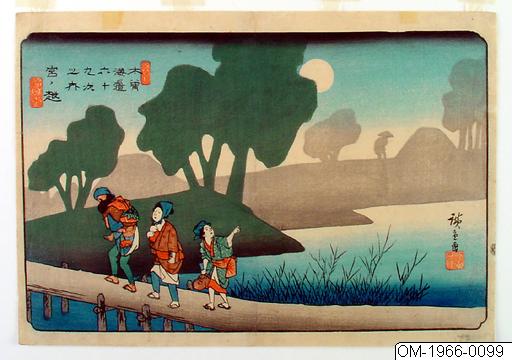
Två kvinnor och en man på en bro, resande på Kisokaido-vägen. En man bär ett äldre barn medan en kvinna bär en baby och en annan bär saker i en furoshiki (omslagstyg). Miyanokoshi. Station 37 ur serien: De sextionio stationerna längs Kisokaido. (The Sixty-Nine Stations of the Kisokaido, Kisokaido rokujuku tsugi). 1834-1842. Flerfärgsträsnitt (nishiki-e), oban-format. /PH Ichiryusai Hiroshige 179...
Visa hela
Två kvinnor och en man på en bro, resande på Kisokaido-vägen. En man bär ett äldre barn medan en kvinna bär en baby och en annan bär saker i en furoshiki (omslagstyg). Miyanokoshi. Station 37 ur serien: De sextionio stationerna längs Kisokaido. (The Sixty-Nine Stations of the Kisokaido, Kisokaido rokujuku tsugi). 1834-1842. Flerfärgsträsnitt (nishiki-e), oban-format. /PH Ichiryusai Hiroshige 1797-1858.
Kisokaido, station nr 37, Miyanokoshi. ca 1840.
TEMP-1180? Kisokaido, eller Nakasendo (”väg som passerar genom de centrala bergen”), som den officiellt heter, var en av Edo-periodens fem största vägar medan namnet Kisokaidō syftar på Kiso-floden som vägen delvis följde. Liksom Tokaido (den största vägen)kopplade den samman Edo och Kyoto men inte längs kusten som Tokaido utan i inlandet. Vägens sträckning har delvis sitt ursprung ända tillbaka till 700-talet. Vägen var inte alls lika populär som Tokaido, mycket på grund av dess mer riskabla passager. Därför dokumenterades sträckan inte lika mycket i reseberättelser och guideböcker, eller bilder för den delen. Hiroshige producerade dock en serie baserad på sträckan tillsammans med Keisai Eisen (1789 - 1851). /PH
Stäng
|
| Anmärkning <itemDescription> |
-
Kompletterad med hjälp av Statens Konstsamlingars tillväxt och förvaltning och Östasiatiska museet och vänförenings årsböcker.
Repro (textskåp)
Vardag
Appendix?
|
| Anmärkning <itemDescription> |
-
Blåtyg box: Hiroshige Kisokaido
Ska ha nr OM-1966-0099 Utställning Galleriet
Uttagen 2/2 2016 PH
|
| Referens, publicerad i <itemDescription> |
-
Braw, Monica, Holmberg, Petra & Myrdal, Eva (2011). Japan: föremål och bilder berättar = Japan : artefacts and images tell the story. Stockholm: Östasiatiska museet
|
| Land, engelska / ursprung <itemDescription> |
|
| Beskrivning, engelska <itemDescription> |
-
Three travellers, two carrying children and the third a bundle wrapped in a cloth (furoshiki). We do not know how far they are going. We see them crossing a bridge in a moonlit landscape. Judging from...
Visa hela
Three travellers, two carrying children and the third a bundle wrapped in a cloth (furoshiki). We do not know how far they are going. We see them crossing a bridge in a moonlit landscape. Judging from the way they are dressed, they are ordinary people, probably peasants. Someone in the distance is wearing a typical straw hat. They have come to the Miyanokoshi-juku posting station (Kiso district, Chūbu region) and are walking along Kisokaidō (Kisokaidō rokujūkyū tsugi no uchi). Multicolour woodblock print (nishiki-e), triptych in ōban tate-e format. (Japan. Bilder och föremål, 2011, s. 40) The 69 stations of the Kisokaido (Japanese: Kisokaido rokujuku tsugi) no. 37. Miyanokoshi (1838-1842).
Kisokaido, or Nakasendo (“road that passes through the central mountains”), as it is officially called, was another of the Edo-period’s five biggest pathways. The name Kisokaido refers to the Kiso river that the road partly followed. Just like Tokaido (see no. 5) it connected Edo and Kyoto but in the inland instead of along the coast. The road’s reach partly originates back to the 700s. It wasn’t nearly as popular as Tokaido, much due to its riskier passages. Therefore, the route wasn’t as documented in traveling stories and guidebooks, nor pictures for that matter. Hiroshige did however produce a series based on the route together with Keisai Eisen (1789-1851). /PH
Stäng
|
| Utställning / tidigare <itemDescription> |
|
| Utställning / tidigare <itemDescription> |
|
| Referens, källa <itemDescription> |
|
| Händelse <context> |
-
Tillverkad av Hiroshige, Ando (senare Utagawa Hiroshige).
-
Brukad 1835-1838 [ca].
-
Ursprung i Japan, Asien.
-
Förvärvad 1966 .
|
| Material, engelska<itemMaterial> |
- paper
|
| Materialkategori<itemMaterial> |
- papper
|
| Material<itemMaterial> |
- papper
|
| Nyckelord <itemKeyWord> |
-
paper
-
시각예술 視覺藝術
-
Andō Hiroshige
-
Google Art 3
-
Ichiryusai Hiroshige
-
Ichiyūsai Hiroshige
-
OM-1966-0099
-
SN33
-
TEMP-1180
-
Utagawa Hiroshige
-
paper
-
Östasien
-
종이 紙
|
| Mått <itemMeasurement> |
-
Bredd: 35 cm.
-
Höjd: 22 cm.
|
| Sakord, engelska<itemName> |
- woodcut
- print
- woodblock
|
| Sakord<itemName> |
- träsnitt
- bildkonst
|
| Ämne <subject> |
|
| Accessionsnummer <itemNumber> |
|
| Tidigare identitet <itemNumber> |
|
| Tidigare identitet <itemNumber> |
|
| Rättigheter för metadata <itemLicense> |

|
| Källa <presOrganization> |
Statens museer för världskultur - Östasiatiska museet |
|
Källa <url>
|
|



 ARTIKLAR I WIKIPEDIA
 ARTIKLAR I WIKIDATA
 BILDER I WIKIMEDIA COMMONS