| Typ <itemType> |
Dokument |
| Datering <presTimeLabel> |
1928 |
| Text i dokument <itemDescription> |
-
Org3 During my last visit to China, together with the Crown Prince of Sweden, I had the opportunity to examine two sites of the Pu Chao Chai type, near Taiyuanfu, the capital of Shansi. From these sites we have brought very interesting ceramics, all of the coerse grey ware, Li-tripods, etc, Also in these cases I have the feeling that the deposits are older than the true Yang Shao, but I cannot pro...
Visa hela
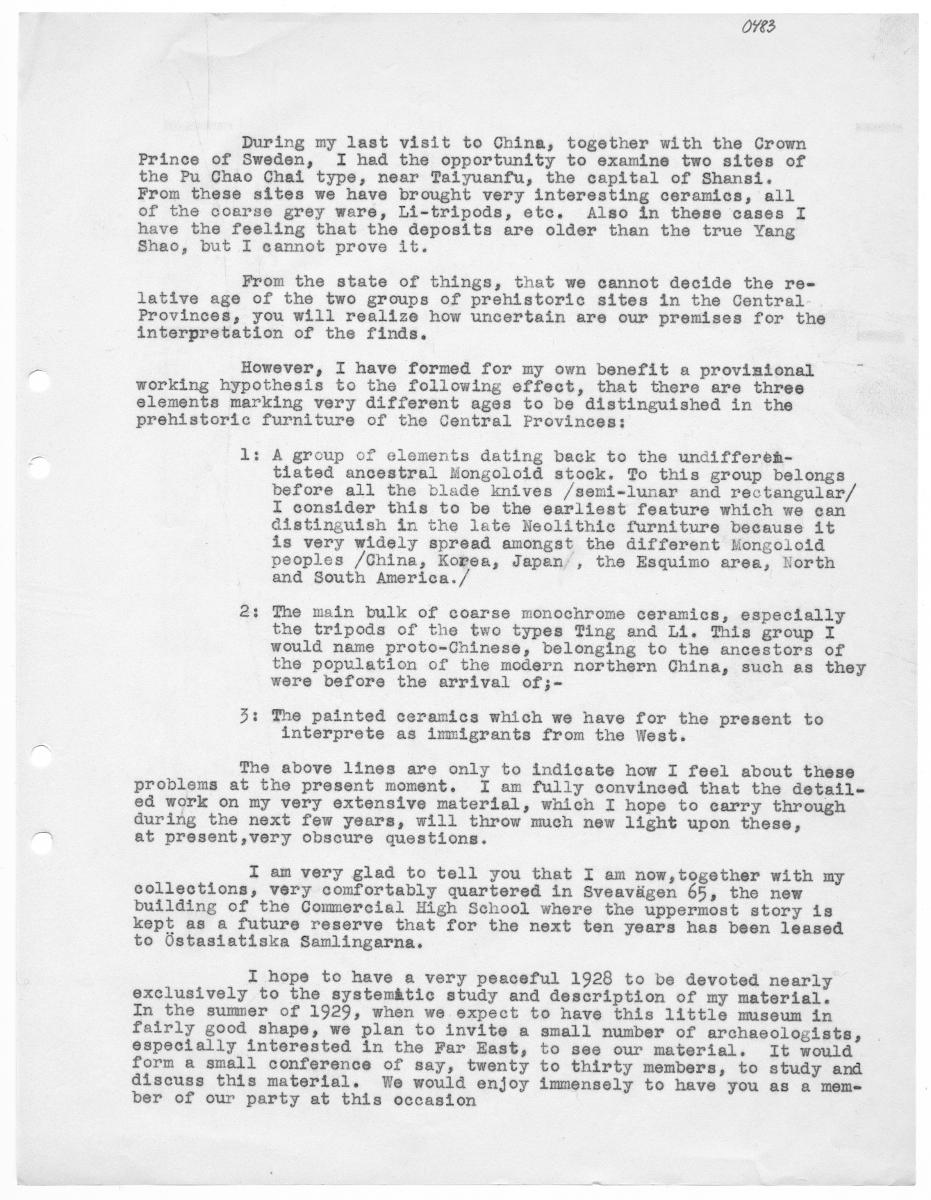
Org3 During my last visit to China, together with the Crown Prince of Sweden, I had the opportunity to examine two sites of the Pu Chao Chai type, near Taiyuanfu, the capital of Shansi. From these sites we have brought very interesting ceramics, all of the coerse grey ware, Li-tripods, etc, Also in these cases I have the feeling that the deposits are older than the true Yang Shao, but I cannot prove it. From the state of things, that we cannot decide the re. lative age of the two groups of prehistoric sites in the Central-. Provinces, you will realize how uncertain are our premises for the interpretation of the finds. However, I have formed for my own benefit a provimional working hypothesis to the following effect, that there are three elements marking very different ages to be distinguished in the prehistoric furniture of the Central Provinces: 1: A group of elements dating back to the undiffereéh- tiated ancestral Mongolold stock. To this group belongs before all the blade knives /semi-lunar and rectangular/ I consider this to be the earliest feature which we can distinguish in the late Neolithic furniture because it is very widely spread amongst the different Mongoloid peoples /China, Korea, Japan, , the Esquimo area, North and South America./ 2: The main bulk of coarse monoechrome ceramics, especially the tripods of the two types Ting and Li, This group I would name proto-Chinese, belonging to the ancestors of the population of the modern northern China, such as they were before the arrival of;- se The painted ceramics which we have for the present to interprete as immigrants from the West. The above lines are only to indicate how I feel about these problems at the present moment. I am fully convinced that the detail- eå work on my very extensive material, which I hope to carry through during the next few years, will throw much new light upon these, at present,very obscure questions. I am very glad to tell you that I am now,together with my collections, very comfortably quartered in Sveavägen 65 , the new building of the Commercial High School where the uppermost story is kept as a future reserve that for the next ten years has been leased to Östasiatiska Samlingarna. I hope to have a very peaceful 1928 to be devoted nearly exclusively to the systemåtic study and description of my material. In the summer of 1929, when we expect to have this little museum in fairly good shape, we plan to invite a small number of archaeologists, especially interested in the Far East, to see our material. It would form a small conference of say, twenty to thirty members, to study and discuss this material. We would enjoy immensely to have you as a mem. ber of our party at this occasion
Stäng
|
| Text i dokument <itemDescription> |
-
or My SL 0782, January 3rd, 1928 Mr, NAO. Nelson, Curator of Archaeology, American Museum of Natural History, New York, N.,Y, Dear Mr. Nelson: Allow me to send to yourself and to Mrs. Nelson my belate...
Visa hela
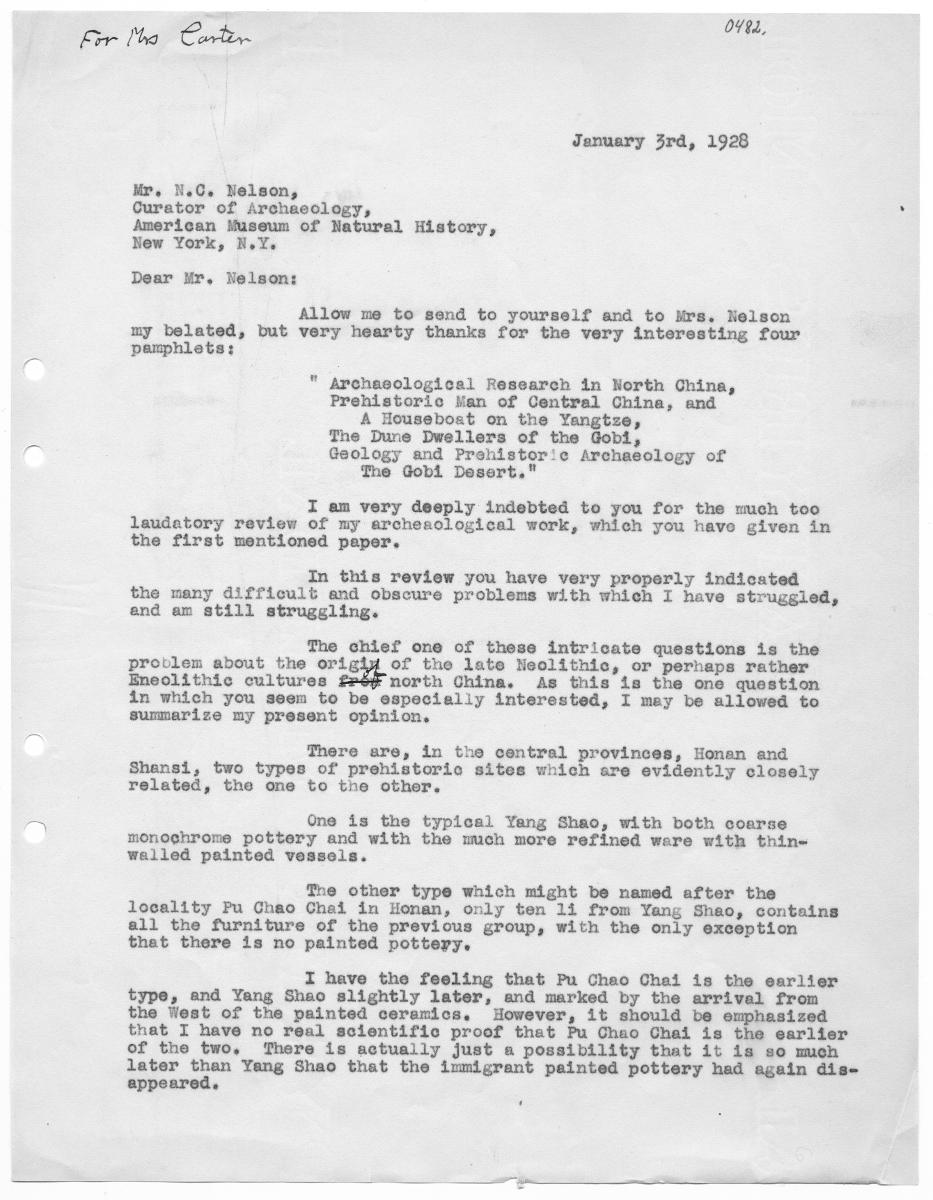
or My SL 0782, January 3rd, 1928 Mr, NAO. Nelson, Curator of Archaeology, American Museum of Natural History, New York, N.,Y, Dear Mr. Nelson: Allow me to send to yourself and to Mrs. Nelson my belated, but very hearty thanks for the very interesting four pamphlets:; " Arehaeological Research in North China, Prehistorie Man of Central Ohina, and 4 Houseboat on the Yangtze, Tne Dune Dwellers of the Gobl, Geology and Prehistoric Arehaeology of The Gobli Desert." I am very deeply indebted to you for the much too laudatory review of my archeaologicel work, which you have given in the first mentioned paper. In this review you have very properly indicated the meny difficult and obscure problems with which I have struggled, end am still struggling. The ehief one of these intricate questions is the problem about the origlia of the late Neolithic, or perhaps rather Eneolithic cultures north China, As this is the one question in which you seem to be especially interested, I mey be allowed to summarize my present opinion, ; There are, in the central provinces, Honan and Shansi, two types of prehistoric sites which are evidently closely related, the one to the other. One is the typical Yang Shao, with both coarse monoehrome pottery and with the much more refined ware with tbin« walled painted vessels. Tne other type which might be named after the locality Pu Chao Chal in Honan, only ten 1i from Yang Shao, contains all the furniture of the previous group, with the only exception tnat there is no painted potteyy. I have the feeling that Pu Chao Ohali is the earlier type, and Yang Sheo slightly later, and marked by the arrivel from the West of the painted ceramics, However, it should be emphasized that I have no real scientific proof that Pu Chao Ohali is the earlier of the two, There is actually just a possibility that it is so much later than Yang Shao that the immigrant painted pottery had again dis- appeared. LU a md FAT SEENESES EN RE AT
Stäng
|
| Text i dokument <itemDescription> |
-
ä | O787 During my last visit to China, together with our Crown Prince, I was fortunate enough to buy quite considerable collections from early historical times, and in addition we have received as a ...
Visa hela
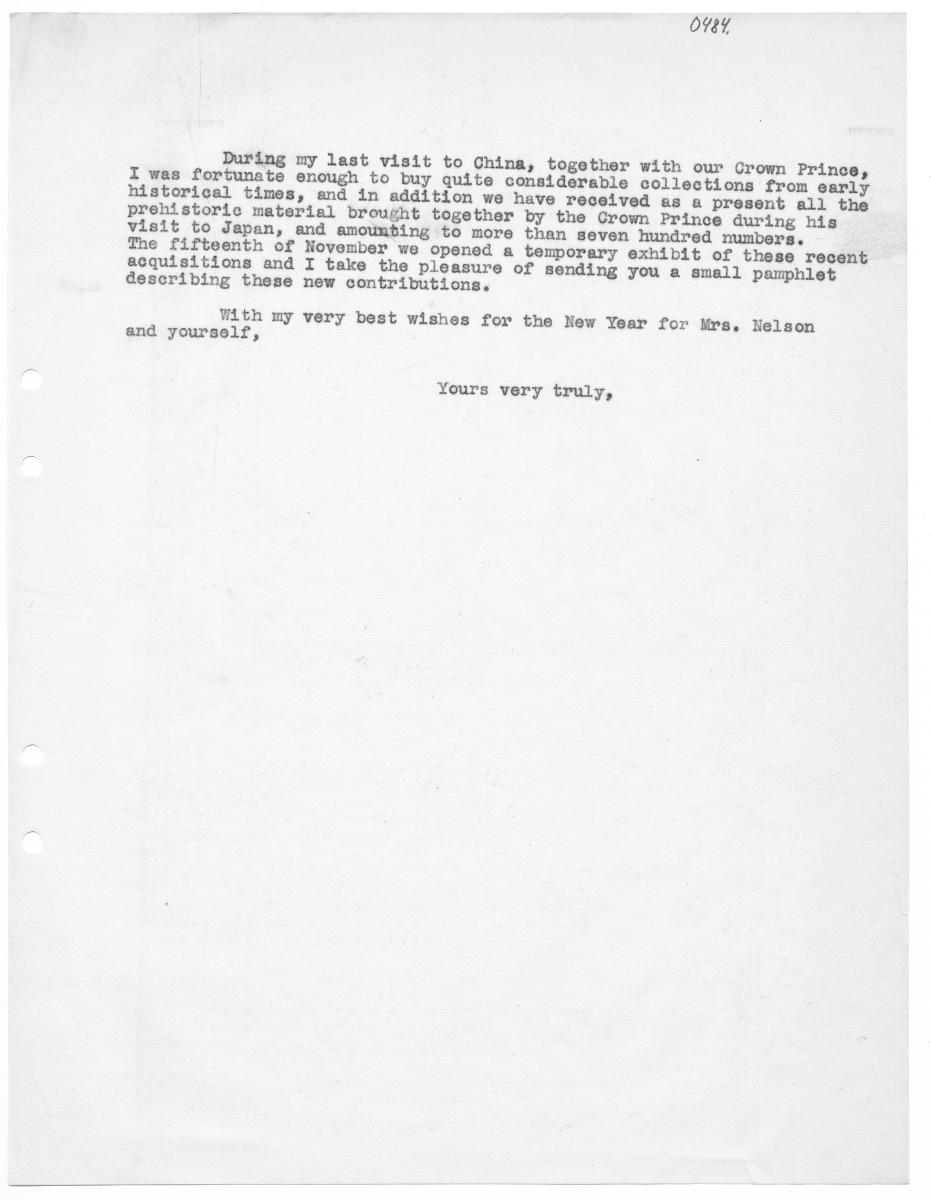
ä | O787 During my last visit to China, together with our Crown Prince, I was fortunate enough to buy quite considerable collections from early historical times, and in addition we have received as a present all the prehistoric material brought together by the Crown Prince during his visit to Japan, and amounding to more than seven hundred numbers. Tne fifteenth of November we opened a temporary exhibit of these recent acquisitions and I take the pleasure of sending you a small pamphlet describing these new contributions. With my very best wishes for the New Year for Mrs, Nelson and yourself, Yours very truly,
Stäng
|
| Händelse <context> |
|
| Nyckelord <itemKeyWord> |
-
E1A-2_0482
-
E1A-2_0482-0484
-
E1A-2_0483
-
E1A-2_0484
|
| Typ av dokument<itemName> |
- brev
|
| Ämne <subject> |
|
| Arkivdokument-ID <itemNumber> |
|
| Tidigare identitet <itemNumber> |
|
| Tidigare identitet <itemNumber> |
|
| Tidigare identitet <itemNumber> |
|
| Rättigheter för metadata <itemLicense> |

|
| Källa <presOrganization> |
Statens museer för världskultur - Östasiatiska museet |
|
Källa <url>
|
|

 ARTIKLAR I WIKIPEDIA
 ARTIKLAR I WIKIDATA
 BILDER I WIKIMEDIA COMMONS