| Text i dokument <itemDescription> |
-
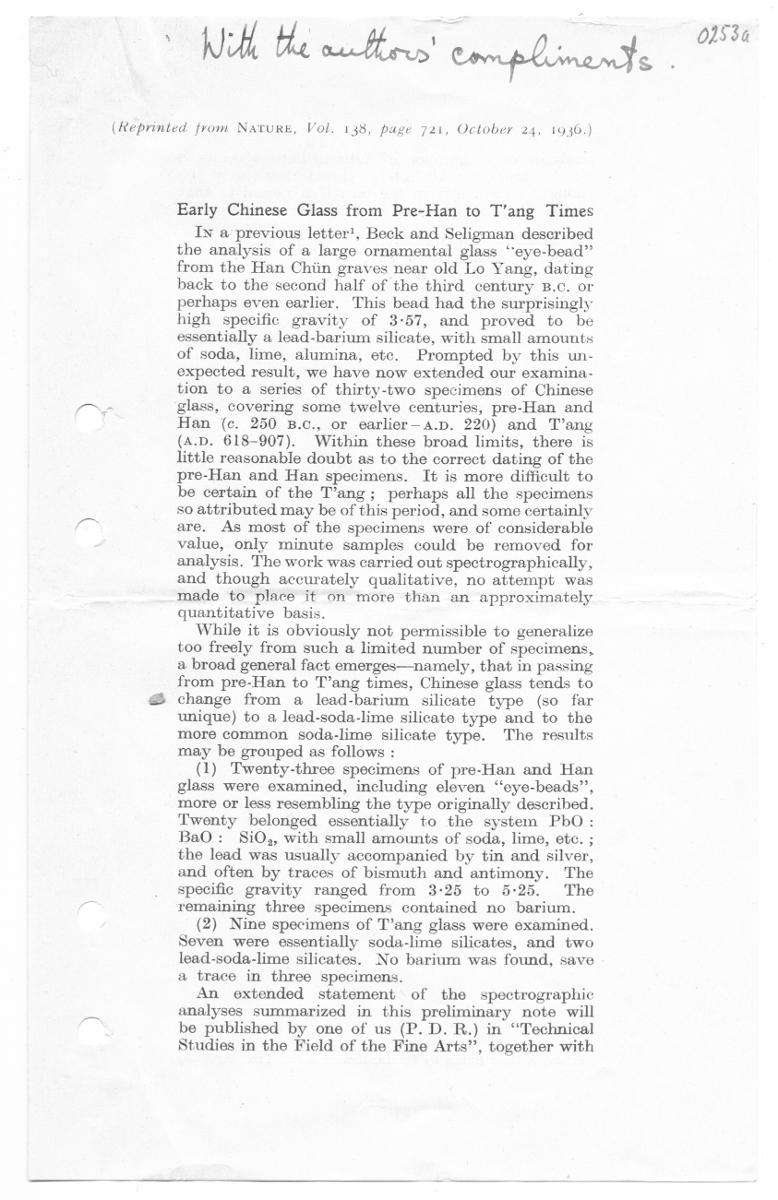
; NH Hi bl , AR 02534 (Reprinted from Nature, Vol. 138, page 721, October 24, 1930.) Early Chinese Glass from Pre-Han to T'ang Times IN a previous letter', Beck and Seligman described the analysis of a large ornamental glass ”eye-bead” from the Han Chän graves near old Lo Yang, dating back to the second half of the third century B.c. or perhaps even earlier, This bead had the surprisingly high spe...
Visa hela
; NH Hi bl , AR 02534 (Reprinted from Nature, Vol. 138, page 721, October 24, 1930.) Early Chinese Glass from Pre-Han to T'ang Times IN a previous letter', Beck and Seligman described the analysis of a large ornamental glass ”eye-bead” from the Han Chän graves near old Lo Yang, dating back to the second half of the third century B.c. or perhaps even earlier, This bead had the surprisingly high specific gravity of 3:57, and proved to be essentially a lead-barium silicate, with small amounts of soda, lime, alumina, ete. Prompted by this un- expected result, we have now extended our examina- tion to a series of thirty-two specimens of Chinese glass, covering some twelve centuries, pre-Han and Han (e. 250 B.c., or earlier—A.p. 220) and T'ang (A.n. 618-907). Within these broad limits, there is little reasonable doubt as to the correct dating of the pre-Han and Han specimens. It is more difficult to be certain of the T'ang ; perhaps all the specimens so attributed may be of this period, and some certainly are. As most of the specimens were of considerable value, only minute samples could be removed for analysis. The work was carried out spectrographically, and though accurately qualitative, no attempt was made to place it on more than an approximately quantitative basis, While it is obviously not permissible to generalize too freely from such a limited number of specimens, a broad general fact emerges—namely, that in passing from pre-Han to T'ang times, Chinese glass tends to BS change from a lead-barium silicate type (so far unique) to a lead-soda-lime silicate type and to the more common soda-lime silicate type. The results may be grouped as follows : (1) Twenty-three specimens of pre-Han and Han glass were examined, including eleven "eye-beads”, more or less resembling the type originally described. Twenty belonged essentially to the system PbO : BaO : SiO,, with small amounts of soda, lime, etc. the lead was usually accompanied by tin and silver, and often by traces of bismuth and antimt The specific gravity ranged from 3:25 to 5-25. The remaining three specimens contained no barium. (2) Nine specimens of T'ang glass were examined. Seven were essentially soda-lime silicates, and two lead-soda-lime silicates. No barium was found, save a trace in three specimens. An extended statement of the spectrographic analyses summarized in this preliminary note will be published by one of us (P. D. R.) in "Technical Studies in the Field of the Fine Arts”, together with
Stäng
|
| Text i dokument <itemDescription> |
-
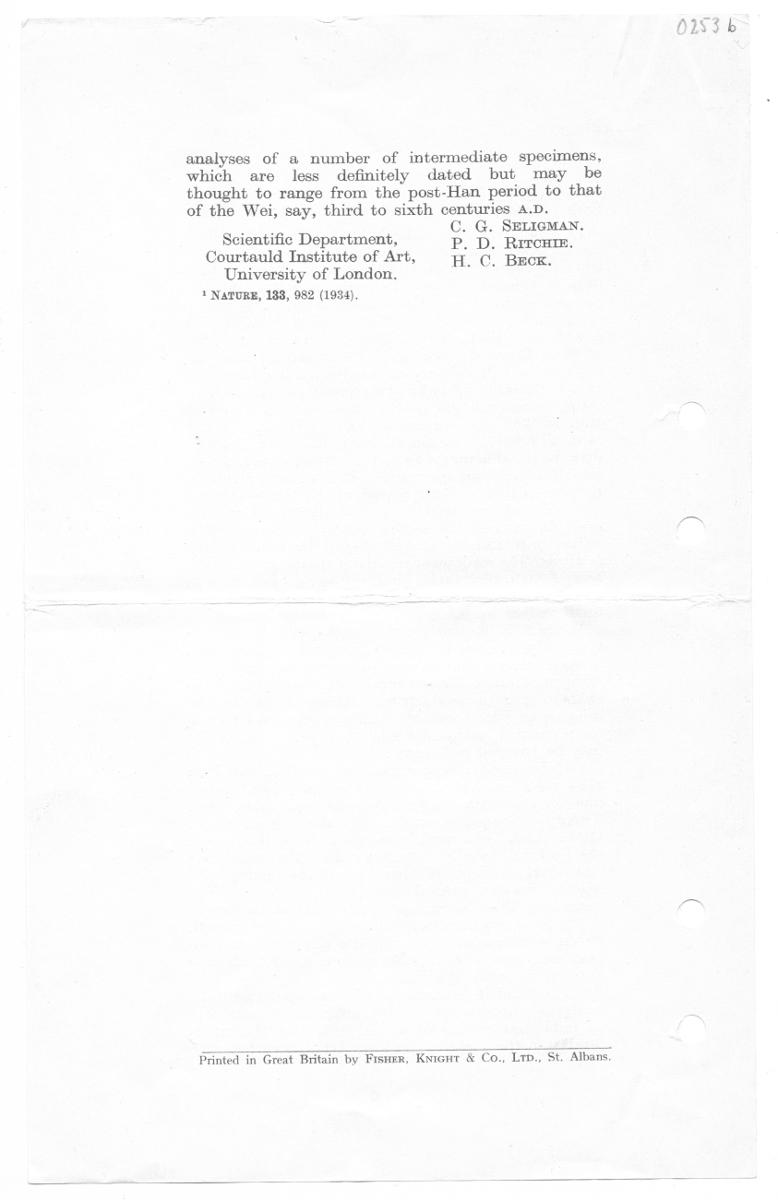
analyses of a number of intermediate specimens, which are less definitely dated but may be thought to range from the post-Han period to that of the Wei, say, third to sixth centuries A.D. C.G. IMAN, S...
Visa hela
analyses of a number of intermediate specimens, which are less definitely dated but may be thought to range from the post-Han period to that of the Wei, say, third to sixth centuries A.D. C.G. IMAN, Scientific Department, pr Så te. Courtauld Institute of Art, — H, C. BECK. University of London. | ! NATURE, 133, 982 (1934), Great Britain by FisweR, KwicHt & Co, Lp, St. Albans,
Stäng
|

 ARTIKLAR I WIKIPEDIA
 ARTIKLAR I WIKIDATA
 BILDER I WIKIMEDIA COMMONS