| Text i dokument <itemDescription> |
-
OT THE CERAMIC REPOSITORY FOR THE EASTERN UNITED STATES UNIVERSITY MUSEUMS BUILDING ANN ARBOR, MICHIGAN. December 17, 1936 Dr. J. Gunnar Andersson Museum of Far Eastern Antiquities Stockholm, Sweden Dear Dr. Andersson: I have just finished reading "Children of the Yellow Earth". It is one of the most interesting and stimulating books that I have read for some time. Your discussions of your geologi...
Visa hela
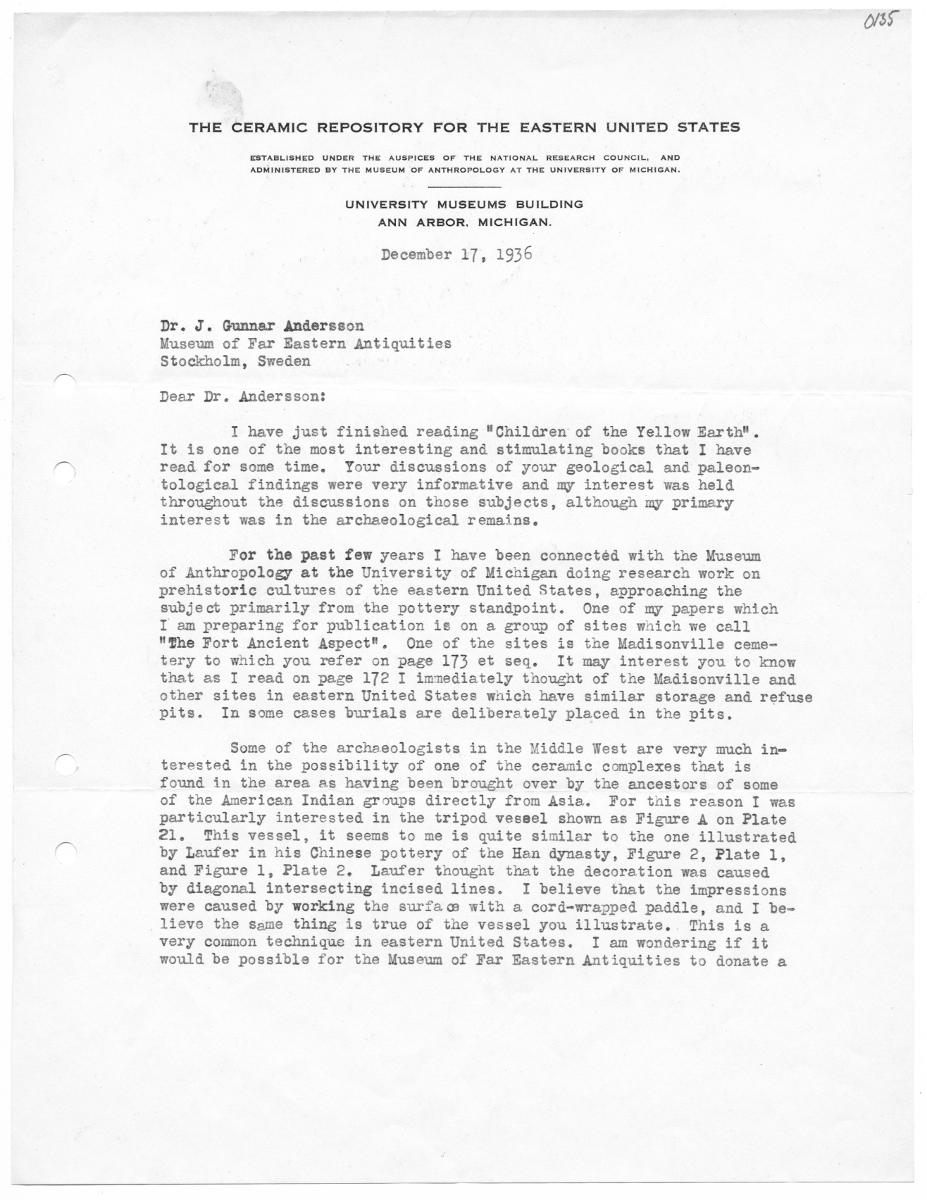
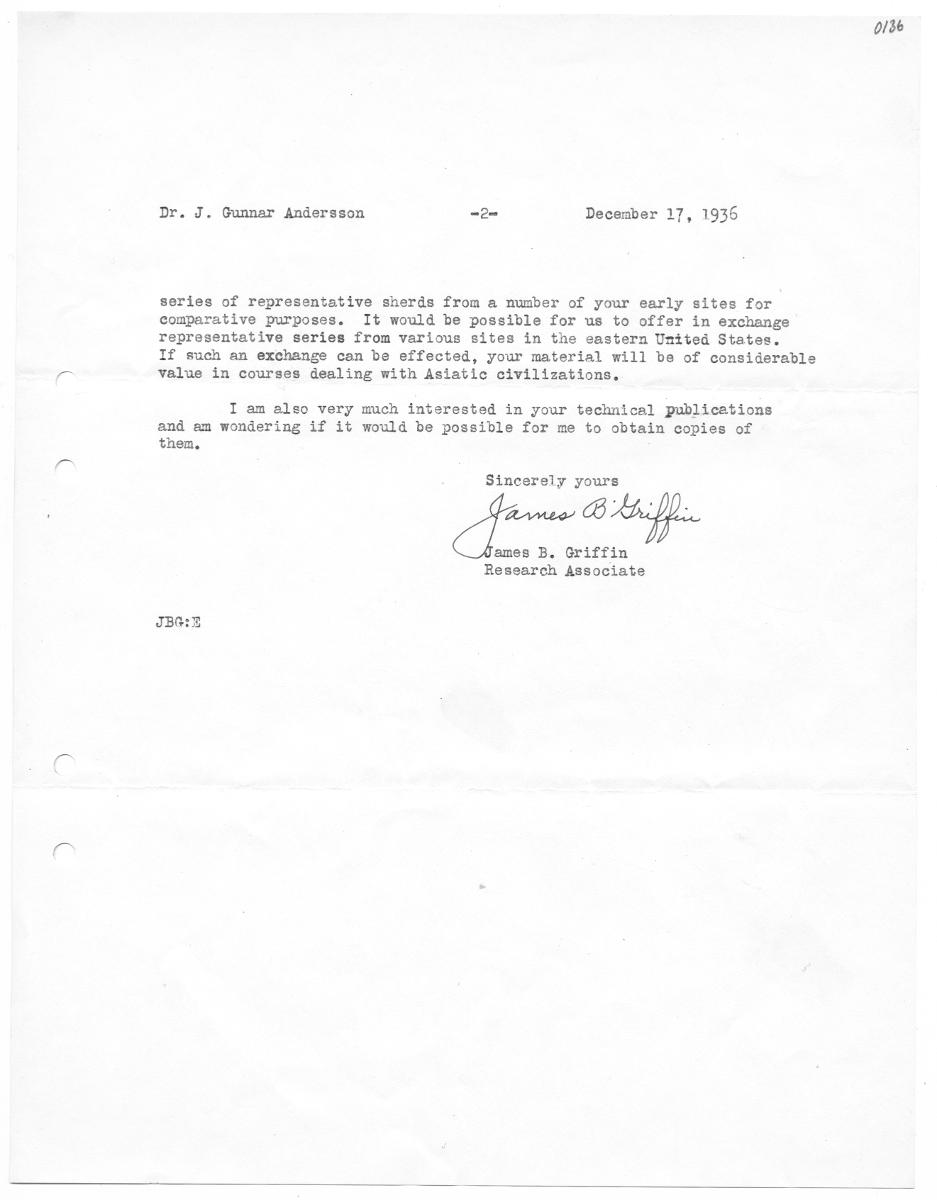
OT THE CERAMIC REPOSITORY FOR THE EASTERN UNITED STATES UNIVERSITY MUSEUMS BUILDING ANN ARBOR, MICHIGAN. December 17, 1936 Dr. J. Gunnar Andersson Museum of Far Eastern Antiquities Stockholm, Sweden Dear Dr. Andersson: I have just finished reading "Children of the Yellow Earth". It is one of the most interesting and stimulating books that I have read for some time. Your discussions of your geological and paleon- tological findings were very informetive and my interest was held throughout the ålscussions on those subjects, although my primary interest was in the archaeological remains. For the past few years I have been connectéd with the Museum of Anthropology at the University of Michigan doing research work on prehistoric cultures of the eastern United States, epproaching the subject primarily from the pottery standpoint. One of my papers which I am preparing for publication is on a group of sites which we call "The Fort Ancient Aspect", One of the sites is the Madisonville ceme- tery to which you refer on page 173 et seq. It may interest you to know that as I read on page 172 I imnediately thought of the Madisonville and other sites in eastern United States which have similar storage and refuse vits. In some cases burials are deliberately placed in the pits. Some of the archseologists in the Middle West are very much in- terested in the possibility of one of the ceranic complexes that is found in the area as having been brought over by the ancestors of some of the American Indian groups directly from Asia. For tais reason I was particularly interested in the tripod vessel shown as Figure A on Plate 21. This vessel, it seems to me is quite similar to the one illustrated by Laufer in his Chinese pottery of the Han dynasty, Figure 2, Plate 1, and Figure 1, Plate 2. Laufer tnought that the decoration was caused by diagonal intersecting incised lines. I believe that the impressions were caused by working the surfaw with a cord-wrapped padåle, and I be- lieve the same thing is true of the vessel you illustrate, This is a very common technique in eastern United States. I am wondering if it would be possible for the Museum of Far Eastern Antiquities to donate a
Stäng
|

 ARTIKLAR I WIKIPEDIA
 ARTIKLAR I WIKIDATA
 BILDER I WIKIMEDIA COMMONS