| Typ <itemType> |
Objekt/föremål |
| Plats <presPlaceLabel> |
Asien, Iran, Luristan, Lorestan |
| Description <itemDescription> |
-
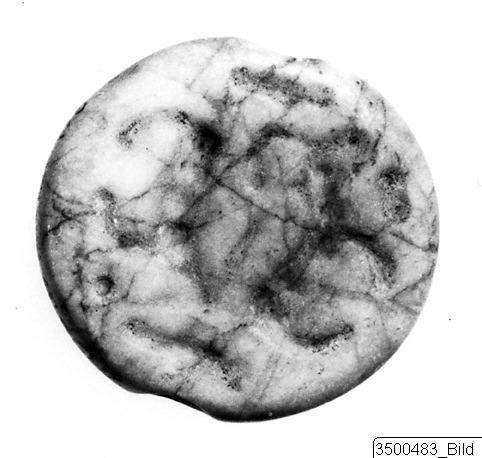
Hemispheric stamp seal with circular base. Calcite/marble - opaque, creamy brown in color with fine brown linear markings throughout matrix. Decor: Two horned goats in tête bêche position: the animals are marked out by joined drill holes, likewise the smaller continuous drill holes for vertical marks at the ends of each animal and also a double drill hole beneath the head of goat facing left and a...
Visa hela
Hemispheric stamp seal with circular base. Calcite/marble - opaque, creamy brown in color with fine brown linear markings throughout matrix. Decor: Two horned goats in tête bêche position: the animals are marked out by joined drill holes, likewise the smaller continuous drill holes for vertical marks at the ends of each animal and also a double drill hole beneath the head of goat facing left and a single drill hole beneath the head of goat facing right. Helen Merillees' catalogue 1995: 2nd half of the 4th millennium B.C. and into the early part of the 3rd millennium B.C. Many examples of this type of hemispheric come from South Mesopotamia and south-west Iran (Susa). This particular example has well defined animals in contrast to other parallels where the drill holes only just resemble some zoomorphic objects. Possibly this seal is closer in date to the 3rd millennium B.C. and linked to the Jemdat Nasr squat drill hole cylinders. Parallels: Keel-Leu 1991, p. 40 no. 40 dated to the Late Uruk, and these examples are considered to come from Elam and Mesopotamia (check other provenanced examples Amiet 1972)
Stäng
|
| Inventory number <itemDescription> |
|
| Acquisition <itemDescription> |
-
Luristan grave find 1936. In a note Arne writes a brief description of how the entire collection was acquired stating there that the numbers 19666, 19818, 21446, 21455, 21456 and 21946 were bought on ...
Visa hela
Luristan grave find 1936. In a note Arne writes a brief description of how the entire collection was acquired stating there that the numbers 19666, 19818, 21446, 21455, 21456 and 21946 were bought on the European art market.
Stäng
|
| Condition <itemDescription> |
|
| Dimensions <itemDescription> |
|
| Cf Publications <itemDescription> |
-
Cf/excavation: Moorey 1978 Kish excavations;
Cf/collection: Buchanan and Moorey 1984 nos 208, 209, stone shape. 208 animal style carving style similar. P. 29: "208: hemispheric, red flecked light brow...
Visa hela
Cf/excavation: Moorey 1978 Kish excavations;
Cf/collection: Buchanan and Moorey 1984 nos 208, 209, stone shape. 208 animal style carving style similar. P. 29: "208: hemispheric, red flecked light brown marble: two horned animals back to back in opposite directions 1924. 323; 40x18; bought Kish expedition. P. 27 Protoliterate period in the south (Mesopotamia and Susa), main centers production in Sumer. Porada Braq, N Syria.
Keel-Leu 1991, p. 40 no. 40 dated to the Late Uruk, and these examples are considered to come from Elam and Mesopotamia (check other provenanced examples Amiet 1972).
Stäng
|
| Country / Findspot <itemDescription> |
|
| Händelse <context> |
-
Förvärvad av Arne, Ture J:son, Statens Historiska museum.
-
Funnen i Lorestan, Iran, Asien.
|
| Material, engelska<itemMaterial> |
- Calcite/marble
|
| Nyckelord <itemKeyWord> |
-
Historiska museet
-
T. J. Arne
-
Ture J. Arne
-
Ture J:son Arne
|
| Mått <itemMeasurement> |
-
Height / Höjd: 1,8 cm.
-
Diameter: 4 cm.
|
| Object<itemName> |
- stamp seal
|
| Ämne <subject> |
|
| Inventory number <itemNumber> |
|
| Rättigheter för metadata <itemLicense> |

|
| Källa <presOrganization> |
Statens museer för världskultur - Medelhavsmuseet |
|
Källa <url>
|
|


 ARTIKLAR I WIKIPEDIA
 ARTIKLAR I WIKIDATA
 BILDER I WIKIMEDIA COMMONS