| Typ <itemType> |
Objekt/föremål |
| Plats <presPlaceLabel> |
Asien, Irak, Nimrud |
| Description <itemDescription> |
-
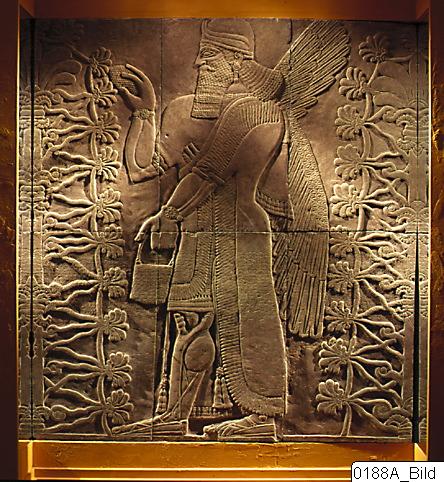
The more than two meter high relief is one of over 400 carved in the soft limestone called 'Mosul marble' that once covered the walls of the major rooms in the Northwest palace of the Assyrian capital Kalhu (Assyrianname) Calah (Biblical name) known today as Nimrud. The relief was excavated by the English in the middle of the 1800's. Assurnarsirpal II, the Neo-Assyrian king who ruled between 883-8...
Visa hela
The more than two meter high relief is one of over 400 carved in the soft limestone called 'Mosul marble' that once covered the walls of the major rooms in the Northwest palace of the Assyrian capital Kalhu (Assyrianname) Calah (Biblical name) known today as Nimrud. The relief was excavated by the English in the middle of the 1800's. Assurnarsirpal II, the Neo-Assyrian king who ruled between 883-859 BC, built the palace. A smaller extension of one of the major dining rooms in the palace contained our wall relief and 18 other similar ones. All but one had the same subject as ours: a winged male protecting genie standing at a stylised tree. The exception was the panel opposite the entrance to the hall which portrayed the king. All traces of the original painting of the reliefs have disappeared.
The genies were portrayed in the same way as the king but have horns and wings instead of the king's crown. In one hand they carry a bucket, in the other a fertility symbol in the form of a pine cone. Across the middle section of this relief as on all the reliefs in the palace is a long cuneiform inscription about the war campaigns Assurnarsipal conducted and how he built the palace.
Stäng
|
| Inventory number <itemDescription> |
|
| Acquisition <itemDescription> |
|
| Comments <itemDescription> |
-
See Swedish text Introduktion p.124 in separate documents.
Sometime before 2000 the relief was returned to Nationalmuseum and a copy was made in plaster (gypsum?). This copy was on display in "room 10...
Visa hela
See Swedish text Introduktion p.124 in separate documents.
Sometime before 2000 the relief was returned to Nationalmuseum and a copy was made in plaster (gypsum?). This copy was on display in "room 10".
Stäng
|
| Condition <itemDescription> |
|
| Dimensions <itemDescription> |
|
| Exhibitions <itemDescription> |
|
| Cf Publications <itemDescription> |
|
| Publications <itemDescription> |
-
- H. Brising, Antik konst i Nationalmuseum, 1911, pl I-II
- Lobell 2002, p. 9
- Meuszynski & Sobolewski 1981, pp. 72, 73, 74, 75, 76,77, Tafel 17 N-15 , plan 8, plan 10 und 11;
- Paley & Sobolewski, ...
Visa hela
- H. Brising, Antik konst i Nationalmuseum, 1911, pl I-II
- Lobell 2002, p. 9
- Meuszynski & Sobolewski 1981, pp. 72, 73, 74, 75, 76,77, Tafel 17 N-15 , plan 8, plan 10 und 11;
- Paley & Sobolewski, 1992;
- Paley & Sobolewski, 1987 plan 2;
- Hallin, Ulrika, ’The Cradle of our Civilization’ in Bearing, The Soya group international magazine, no 3 2003, p. 22-25.
Stäng
|
| Published text <itemDescription> |
-
Relief, Assyria, c. 875-860 BC
Winged genie with pail and stylized tree from Ashurmasirpal II's palace in Nimrud (Northwest Palace, room L). The cuneiform inscription is a tribute to the king, listing...
Visa hela
Relief, Assyria, c. 875-860 BC
Winged genie with pail and stylized tree from Ashurmasirpal II's palace in Nimrud (Northwest Palace, room L). The cuneiform inscription is a tribute to the king, listing his titles and achievements. It is repeated in many places in the palace.
Gypsum Dime stone), in sls parts NMAnt 2339, Gift 1066 Dowager Queen Josefina (Nationalmuseum 2025)
Stäng
|
| Published text <itemDescription> |
-
Relief, Assyrien, ca 875-860 f. Kr.
Bevingad skyddsande med ämbar och stiliserat träd från Assurnasirpal II:s palats i Nimrud (Nordväst-palatset, rum L). Kilskriftsinskriptionen är en hyllning till ku...
Visa hela
Relief, Assyrien, ca 875-860 f. Kr.
Bevingad skyddsande med ämbar och stiliserat träd från Assurnasirpal II:s palats i Nimrud (Nordväst-palatset, rum L). Kilskriftsinskriptionen är en hyllning till kungen och räknar upp hans titlar och bedrifter. Den upprepas på många ställen i palatset.
Kalksten, i sex delar.
NMAnt 2339. Gåva 1066 änkedrottning Josefina. (utställningstext, Nationalmuseum, 2025)
Stäng
|
| Exhibition / Previously <itemDescription> |
|
| Exhibition / Previously <itemDescription> |
|
| Exhibition / Previously <itemDescription> |
|
| Country / Findspot <itemDescription> |
|
| Händelse <context> |
-
Förvärvad av Josefina, drottning av Sverige och Norge.
-
Funnen i Nimrud, Irak, Asien.
-
Ägd av Nationalmuseum, Stockholm.
|
| Material, engelska<itemMaterial> |
- Limestone
|
| Nyckelord <itemKeyWord> |
-
NM Ant 0856
-
NM Sk 0856
-
Room 7
-
Room 8
-
Josefina av Leuchtenberg
-
Josephina Maximiliana Eugenia
-
Joséphine
|
| Mått <itemMeasurement> |
-
Length / Längd: 212 cm.
-
Width / Bredd: 234 cm.
|
| Object, Swedish<itemName> |
- relief
- avfört
- återlämnat
|
| Object<itemName> |
- relief
- deaccessioned
- returned
|
| Ämne <subject> |
|
| Inventory number <itemNumber> |
|
| Previous ID <itemNumber> |
|
| Previous ID <itemNumber> |
|
| Rättigheter för metadata <itemLicense> |

|
| Källa <presOrganization> |
Statens museer för världskultur - Medelhavsmuseet |
|
Källa <url>
|
|


 ARTIKLAR I WIKIPEDIA
 ARTIKLAR I WIKIDATA
 BILDER I WIKIMEDIA COMMONS