| Typ <itemType> |
Objekt/föremål |
| Datering <presTimeLabel> |
Ca 1260-1235 BC. |
| Plats <presPlaceLabel> |
Asien, Iran, Elam |
| Description <itemDescription> |
-
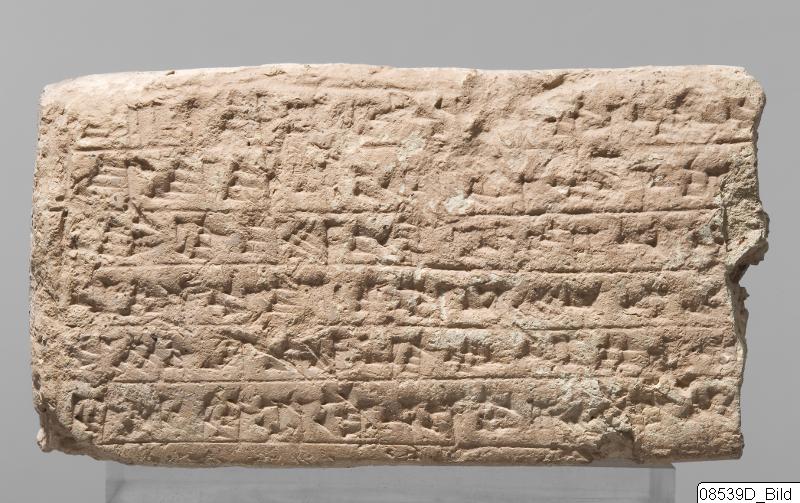
This fragmentary brick is inscribed with an inscription of Untash-Napirisha, who was king of Elam during the Middle Elamite Period. He founded a new capital called either Al-Untash-Napirisha (‘City of Untash-Napirisha’) or Dur-Untash (‘Fortress of Untash’), modern Choga Zanbil, on a low ridge 40 km south-east of Susa in what is now the Khuzistan province of western Iran. French archaeologists exca...
Visa hela
This fragmentary brick is inscribed with an inscription of Untash-Napirisha, who was king of Elam during the Middle Elamite Period. He founded a new capital called either Al-Untash-Napirisha (‘City of Untash-Napirisha’) or Dur-Untash (‘Fortress of Untash’), modern Choga Zanbil, on a low ridge 40 km south-east of Susa in what is now the Khuzistan province of western Iran. French archaeologists excavated the site 1936-1939 and 1951-1962. The large temple tower in the middle of the temple area in the centre of the city is the best preserved of all ziggurats excavated. Remains of glazed bricks from the facade of the ziggurat have been found. In the final publication of the inscribed bricks from Choga Zanbil, M-j. Steve referred to more than 5000 inscribed bricks excavated in this city. Most of them had Elamite inscriptions, but some were inscribed in Akkadian. The most common inscribed bricks, some 70 % of the total number, had the same Elamite text as on our brick. A total of 662 bricks with this inscription were still found in situ in the walls of ziggurrat. A limited number of bricks with this inscription were also reported to have been found in Susa. The inscription describes how the king Untash-Napirisha, with the Elamite royal title king of Anshan and Susa, constructed the ziggurat-temple called Siyankuk in his new capital. Our brick was evidently intended for this ziggurat, and it seems reasonable to assume that it was built into the walls of this building as were the numerous duplicates referred to above. The donator served at the time of the acquisition of the brick at the Swedish legation in Teheran. When he donated it 37 years later, it may be assumed that he had forgotten that one of the bricks was not from Babylon, but possibly purchased somewhere in Iran. Due to our present state of knowledge of Elamite, there is some uncertainty in the translation below; these parts of the translation are in Italics. “I, Untash-Napirisha, son of [Humban-numena, king of Anshan and ] Susa, [wanted to prolong] my life [ and my good reign, and to avoid] any discontinuity of my prosperous (royal) line, [therefore] I built this temple of baked bricks, [and the high temple of glazed bricks. I gave it] to the god Inshushinak of (the temple) Siyankuk (‘Temple-protection’). I consecrated [the temple tower (ziggurat)]. What I made and created, [has been given by me as a gift to the god Inshushinak].”
Stäng
|
| Inventory number <itemDescription> |
|
| Acquisition <itemDescription> |
-
Ambassador Carl Bergenstråhle (1909-1977) donated three bricks to the Medelhavsmuseet in 1976. He purchased them when he served as secretary of Swedish legation in Teheran in 1940. When he donated the...
Visa hela
Ambassador Carl Bergenstråhle (1909-1977) donated three bricks to the Medelhavsmuseet in 1976. He purchased them when he served as secretary of Swedish legation in Teheran in 1940. When he donated them to the Medelhavsmuseet, he claimed that they came from a wall in the northeastern part of the south palace in Babylon where R. Koldewey assumed that the “hanging gardens” were situated. This information is probably correct for two of the bricks (MM 1977:23b and MM 1977:23c). However, the third brick (MM 1977:23a) seems to be from Choga Zanbil in western Iran.
Stäng
|
| Condition <itemDescription> |
|
| Dimensions <itemDescription> |
|
| Cf Publications <itemDescription> |
|
| Publications <itemDescription> |
|
| Exhibition / Previously <itemDescription> |
|
| Country / Findspot <itemDescription> |
|
| Exhibition, Part of / Previously <itemDescription> |
|
| Referens, publicerad i <itemDescription> |
|
| Händelse <context> |
-
Brukad Ca 1260-1235 BC..
-
Funnen i Elam, Iran, Asien.
|
| Material, engelska<itemMaterial> |
- Clay
- Pottery
|
| Material<itemMaterial> |
- Keramik
|
| Nyckelord <itemKeyWord> |
-
Ca 1260-1235 BC.
-
Room 9
-
Västasien
-
ceramics
|
| Mått <itemMeasurement> |
-
Thickness / Tjocklek: 17 cm.
|
| Object<itemName> |
- inscription
- brick
|
| Ämne <subject> |
|
| Inventory number <itemNumber> |
|
| Rättigheter för metadata <itemLicense> |

|
| Källa <presOrganization> |
Statens museer för världskultur - Medelhavsmuseet |
|
Källa <url>
|
|



 ARTIKLAR I WIKIPEDIA
 ARTIKLAR I WIKIDATA
 BILDER I WIKIMEDIA COMMONS