| Typ <itemType> |
Objekt/föremål |
| Plats <presPlaceLabel> |
Asien, Turkiet |
| Description <itemDescription> |
|
| Inventory number <itemDescription> |
|
| Acquisition <itemDescription> |
|
| Comments <itemDescription> |
-
Kula type, has belonged to the private collection of R. Christensen, Stockholm.
The rug is vacuum-cleaned, and surface dust was taken away with a soft bruch. It is rolled up on a paper stafetta, and w...
Visa hela
Kula type, has belonged to the private collection of R. Christensen, Stockholm.
The rug is vacuum-cleaned, and surface dust was taken away with a soft bruch. It is rolled up on a paper stafetta, and wrapped into a cotton cover.
Flyttas till Etnografiska.
Stäng
|
| Condition <itemDescription> |
|
| Dimensions <itemDescription> |
|
| Publications <itemDescription> |
-
Sterner, M., Orientens Mattor, Stockholm 1959, p. 204.
|
| Published text <itemDescription> |
-
This rug belongs to the group of prayer rugs from Ghiordes, a village between Izmir and Ushak, where most of the Anatolian prayer rugs were manufactured in the AH 12th–13th / AD 18th–19th centuries. I...
Visa hela
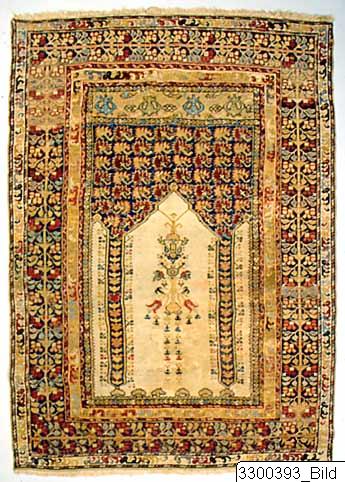
This rug belongs to the group of prayer rugs from Ghiordes, a village between Izmir and Ushak, where most of the Anatolian prayer rugs were manufactured in the AH 12th–13th / AD 18th–19th centuries. It shows in the central field a pointed niche with a half-niche on each side on a cream background. The motif of the three-arched niche derives from rug patterns of Ottoman courtly manufacturing during the AH 10th–11th / AD 16th–17th centuries. In contrast to these original designs, the columns of this rug are based on stylised carnations. Edged with trefoiled blossoms they support the main niche and separate it from the half-niches. The spandrels are filled with stylised carnations on a dark-blue background. A large bouquet of flowers hangs in the apex, reaching nearly to the bottom where a row of carnations is presented. The panel above the spandrels is filled with rosette blossoms and ornaments.
The border is formed by two horizontal and two vertical stripes showing an endless pattern of stylised plants on a dark blue background. The wavy motif of a flower scroll alternately coloured in blue, red and tan is repeated on the inner and outer guard bands. Source: [https://islamicart.museumwnf.org/database_item.php?id=object;ISL;se;Mus01;4;en&cp] How date and origin were established:
A very similar rug is dated to the 12th / 18th century. How Object was obtained:
Acquired from the carpet dealer P. Willborg, Stockholm, in 1984. The rug belonged to the collection of R. Christensen, Stockholm. How provenance was established:
Rugs showing similar designs and colour schemes are usually ascribed to the Ghiordes group. Source: [https://islamicart.museumwnf.org/database_item.php?id=object;ISL;se;Mus01;4;en&cp]
Stäng
|
| Source / http <itemDescription> |
|
| Loan out / Current <itemDescription> |
|
| Name / Loantaker <itemDescription> |
|
| Description, Swedish <itemDescription> |
|
| Händelse <context> |
-
Ursprung i Turkiet, Asien.
|
| Material, engelska<itemMaterial> |
- Wool
|
| Nyckelord <itemKeyWord> |
|
| Mått <itemMeasurement> |
|
| Object<itemName> |
- rug (for prayer)
|
| Ämne <subject> |
|
| Inventory number <itemNumber> |
|
| Previous ID <itemNumber> |
|
| Rättigheter för metadata <itemLicense> |

|
| Källa <presOrganization> |
Statens museer för världskultur - Medelhavsmuseet |
|
Källa <url>
|
|


 ARTIKLAR I WIKIPEDIA
 ARTIKLAR I WIKIDATA
 BILDER I WIKIMEDIA COMMONS