| Typ <itemType> |
Objekt/föremål |
| Datering <presTimeLabel> |
Hellenistic |
| Plats <presPlaceLabel> |
Asien, Turkiet, Reported to have been fond in the vicinity of Sardes. |
| Description <itemDescription> |
-
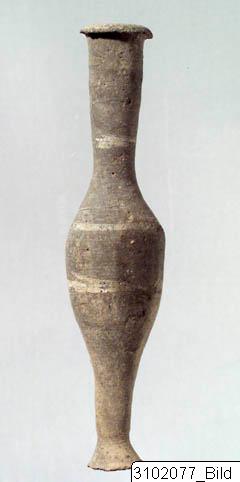
An unguentarium (pl. unguentaria) is a small container, typically made of clay or glass, for oil and perfumes. They are mostly associated with Hellenistic and Roman contexts, especially as grave goods.
|
| Description <itemDescription> |
-
Fusiform unguentarium. Slender shape with tall, hollowed stem. Flat, flaring base. Tall, narrow neck, tapering slightly toward the base Sloping lip. Rough surface. Narrow, painted bands around neck an...
Visa hela
Fusiform unguentarium. Slender shape with tall, hollowed stem. Flat, flaring base. Tall, narrow neck, tapering slightly toward the base Sloping lip. Rough surface. Narrow, painted bands around neck and body. Fine, Greyish-brown fabric with fine, sparse mica. Diluted white paint.
Stäng
|
| Inventory number <itemDescription> |
|
| Acquisition <itemDescription> |
-
Acquired at Sardis by the Swedish-Norwegian Consul at Smyrna, Mr. F. W. Spiegelthal. Given by him to the then Prince Oscar, later King Oscar II, who in his turn donated it to the National Museum in 18...
Visa hela
Acquired at Sardis by the Swedish-Norwegian Consul at Smyrna, Mr. F. W. Spiegelthal. Given by him to the then Prince Oscar, later King Oscar II, who in his turn donated it to the National Museum in 1868.
Stäng
|
| Comments <itemDescription> |
-
An unguentarium (pl. unguentaria) is a small container, typically made of clay or glass, for oil and perfumes. They are mostly associated with Hellenistic and Roman contexts, especially as grave goods...
Visa hela
An unguentarium (pl. unguentaria) is a small container, typically made of clay or glass, for oil and perfumes. They are mostly associated with Hellenistic and Roman contexts, especially as grave goods. The so-called fusiform shape (from the Latin fusus, meaning “spindle”) is characteristic of Hellenistic unguentaria and is thought to have developed functionally from the lekythos. On the other hand, the so-called piriform shape (from the Latin pirus, meaning “pear”) is characteristic of the Roman era, especially the early Principate.
Stäng
|
| Condition <itemDescription> |
|
| Dimensions <itemDescription> |
|
| Country / Findspot <itemDescription> |
|
| Händelse <context> |
-
Förvärvad av Oscar II.
-
Insamlad av Spiegelthal , Friedrich Wilhelm.
-
Brukad Hellenistic.
-
Funnen i Reported to have been fond in the vicinity of Sardes., Turkiet, Asien.
-
Ägd av Nationalmuseum, Stockholm.
|
| Material, engelska<itemMaterial> |
- Clay
- Earthenware
- Pottery
|
| Material<itemMaterial> |
- Keramik
|
| Nyckelord <itemKeyWord> |
-
Hellenistic
-
Oscar II
-
balsamarium
-
ceramics
-
lacrimarium
-
pottery
-
vessel
|
| Mått <itemMeasurement> |
|
| Object, Swedish<itemName> |
- flaska
- kärl
|
| Object<itemName> |
- unguentarium
|
| Ämne <subject> |
|
| Inventory number <itemNumber> |
|
| Rättigheter för metadata <itemLicense> |
|
| Källa <presOrganization> |
Statens museer för världskultur - Medelhavsmuseet |
|
Källa <url>
|
|