| Typ <itemType> |
Objekt/föremål |
| Datering <presTimeLabel> |
Archaic |
| Plats <presPlaceLabel> |
Europa, Italien |
| Description <itemDescription> |
-
Broad disc-shaped rim, sloping inwards; narrow neck; lug handle below rim; ovoid body; flattened base; a shallow, circular depression on bottom centre. Semilustrous, very pale brown clay; lustrous, black to brown paint — partly misfired to red; added red. Band on inside of mouth; red and brown tongues on rim top; a row of dots on side of rim; a vertical row of dots on handle; tongues encircling ne...
Visa hela
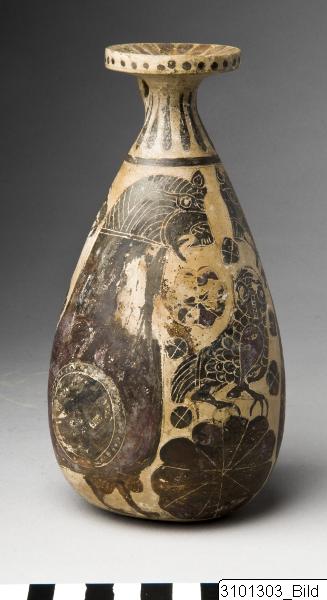
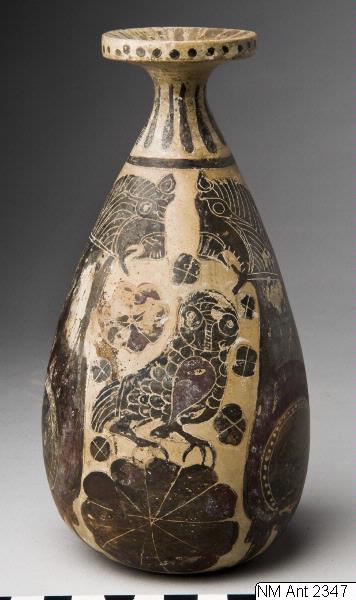
Broad disc-shaped rim, sloping inwards; narrow neck; lug handle below rim; ovoid body; flattened base; a shallow, circular depression on bottom centre. Semilustrous, very pale brown clay; lustrous, black to brown paint — partly misfired to red; added red. Band on inside of mouth; red and brown tongues on rim top; a row of dots on side of rim; a vertical row of dots on handle; tongues encircling neck; on body two antithetical, seated lions and a small owl in between; on their bodies two concentric, incised circles with added white dots, surrounded by a zone of added red; the lions sit back to back, with their tails intertwined; above the tails is a bird with added red on the wings; incised blobs and rosettes as filling pattern; one band above figures and one below; dense tongues and a band on underside.
Stäng
|
| Inventory number <itemDescription> |
|
| Acquisition <itemDescription> |
|
| Comments <itemDescription> |
-
Needs desalting (?). Urval Galleriet. Äldre bilder A.Stalteri Marcus.
|
| Comments <itemDescription> |
-
An alabastron (pl. alabastra) is a long-bodied vessel, typically with a rounded bottom. It is usually without a handle, although some examples have short handles (or eyes or lugs) through which a stri...
Visa hela
An alabastron (pl. alabastra) is a long-bodied vessel, typically with a rounded bottom. It is usually without a handle, although some examples have short handles (or eyes or lugs) through which a string could be attached. The name is derived from alabaster, the white-ground stone that the earliest examples were carved from. They seem to primarily have been a vessel for perfumed oil, as indicated by scenes on vases depicting it being used by women after bathing.
Stäng
|
| Condition <itemDescription> |
|
| Dimensions <itemDescription> |
|
| Exhibitions <itemDescription> |
|
| Cf Publications <itemDescription> |
|
| Publications <itemDescription> |
-
Ch. Wikander, ‘Two names — one hand. A new alabastron by tthe Pascia Romana Painter’, MedMusB 24, 1989, 13-18. J. G. Szilàgyi, Ceramica etrusco-corinzia figurata 1 (Monumenti Etruschi 7), Florence 199...
Visa hela
Ch. Wikander, ‘Two names — one hand. A new alabastron by tthe Pascia Romana Painter’, MedMusB 24, 1989, 13-18. J. G. Szilàgyi, Ceramica etrusco-corinzia figurata 1 (Monumenti Etruschi 7), Florence 1992, 206 n°42).
Stäng
|
| Pottery Ware <itemDescription> |
|
| Pottery Ware <itemDescription> |
|
| Utställning / ingår i <itemDescription> |
|
| Exhibition / Previously <itemDescription> |
|
| Country / Findspot <itemDescription> |
|
| Exhibition, Part of / Current <itemDescription> |
|
| Geographic name, alternative <itemDescription> |
|
| Referens, publicerad i <itemDescription> |
|
| Händelse <context> |
-
Brukad Archaic.
-
Funnen i Italien, Europa.
-
Ägd av Nationalmuseum, Stockholm.
|
| Material, engelska<itemMaterial> |
- Pottery
- Earthenware
- Clay
|
| Material<itemMaterial> |
- Keramik
|
| Nyckelord <itemKeyWord> |
|
| Mått <itemMeasurement> |
-
Height / Höjd: 18,7 cm.
-
Diameter: 5,7 cm.
|
| Object<itemName> |
- alabastron
|
| Ämne <subject> |
|
| Inventory number <itemNumber> |
|
| Rättigheter för metadata <itemLicense> |
|
| Källa <presOrganization> |
Statens museer för världskultur - Medelhavsmuseet |
|
Källa <url>
|
|