| Typ <itemType> |
Objekt/föremål |
| Description <itemDescription> |
-
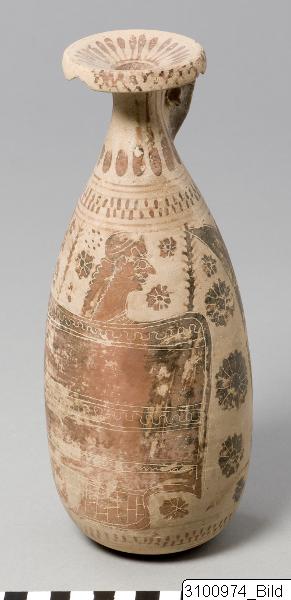
Broad disc rim, sloping inwards; narrow neck; lug handle at neck; elongated body; flattened base. Porous, yellowish brown clay; pale brown slip; dark brown paint, largely misfired to red; incisions. Tongues on rim top; crosses on edge of rim; handle painted; elongated tongues on neck; on body two standing women seen in profile, sharing the same mantle; the mantle is decorated with wavy lines and z...
Visa hela
Broad disc rim, sloping inwards; narrow neck; lug handle at neck; elongated body; flattened base. Porous, yellowish brown clay; pale brown slip; dark brown paint, largely misfired to red; incisions. Tongues on rim top; crosses on edge of rim; handle painted; elongated tongues on neck; on body two standing women seen in profile, sharing the same mantle; the mantle is decorated with wavy lines and zigzags between bands; in front of the heads of both women a stylised plant ornament; both women have long, curly hair fastened with a fillet ; on opposite side of body, below handle, a large lotus flower with incised cross-hatching, zigzags and wavy lines; incised rosettes and dot rosettes as filling ornaments; above and below the picture are two rows of dots between horizontal lines; on underside dense tongues and three concentric circles around the central dot.
Stäng
|
| Inventory number <itemDescription> |
|
| Comments <itemDescription> |
-
Urval Galleriet. Äldre bild A.Stalteri Marcus.
|
| Comments <itemDescription> |
|
| Comments <itemDescription> |
-
An alabastron (pl. alabastra) is a long-bodied vessel, typically with a rounded bottom. It is usually without a handle, although some examples have short handles (or eyes or lugs) through which a stri...
Visa hela
An alabastron (pl. alabastra) is a long-bodied vessel, typically with a rounded bottom. It is usually without a handle, although some examples have short handles (or eyes or lugs) through which a string could be attached. The name is derived from alabaster, the white-ground stone that the earliest examples were carved from. They seem to primarily have been a vessel for perfumed oil, as indicated by scenes on vases depicting it being used by women after bathing.
Stäng
|
| Condition <itemDescription> |
|
| Dimensions <itemDescription> |
|
| Pottery Ware <itemDescription> |
|
| Pottery Ware <itemDescription> |
|
| Händelse <context> |
-
Ägd av Nationalmuseum, Stockholm.
|
| Material, engelska<itemMaterial> |
- Clay
- Earthenware
- Pottery
|
| Material<itemMaterial> |
- Keramik
|
| Nyckelord <itemKeyWord> |
-
NM “SW” S.N. 0018
-
NM-fel 2015:1: Åtgärdad
-
S.N. 0018
-
ceramics
|
| Mått <itemMeasurement> |
-
Height / Höjd: 24,5 cm.
-
Diameter: 6,2 cm.
|
| Object<itemName> |
- alabastron
|
| Ämne <subject> |
|
| Inventory number <itemNumber> |
|
| Previous ID <itemNumber> |
|
| Previous ID <itemNumber> |
|
| Rättigheter för metadata <itemLicense> |
|
| Källa <presOrganization> |
Statens museer för världskultur - Medelhavsmuseet |
|
Källa <url>
|

|