| Typ <itemType> |
Samling |
| Beskrivning <itemDescription> |
|
| Förvärvsomständigheter / till museet <itemDescription> |
|
| Entré till samlingen <itemDescription> |
-
Samlingen, bestående av Leo Westphals indiandräkt för hans deltaganden runt 1930 i Cirkus Brazil Jack, är viktig pga den kulturhistoriska betydelse som indianer de facto har haft i Sverige, ända sed...
Visa hela
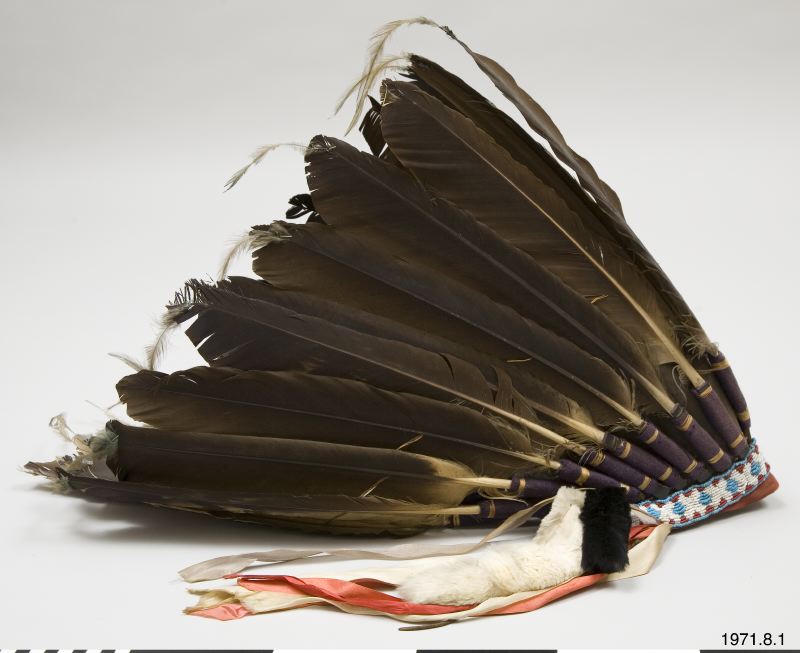
Samlingen, bestående av Leo Westphals indiandräkt för hans deltaganden runt 1930 i Cirkus Brazil Jack, är viktig pga den kulturhistoriska betydelse som indianer de facto har haft i Sverige, ända sedan kuriosakabinetten/Kunst-und-Wunderkammern/ och karusellerna (festligheter) på slott och herresäten under 1500- och 1600-talen. Under en karusell kunde man vara utklädd till "wildman" (t.ex. som en indian) och agera den rollen. Med tiden kom indian-fenomenet (t.ex. populär litteratur, ungdomsböcker, serietidningar, leksaker, dräkter, fjäderbuskar,sommarens indiantält) nå ut till altt fler samhällsgrupper. En turnerande cirkus på 1900-talet hade ofta indianer på programmet men det var inte alltid äkta indianer... Delar av samlingen är utställd i museets Nordamerika-utställning, öppnad 2008. För indianer i Vilda Västern-shower, se bl.a. L.G. Moses, Wild West Shows and the Images of American Indians 1883-1933 (1996). SB, 2012-02-29.
Stäng
|
| Introduction to the collection <itemDescription> |
-
The collection, consisting of Leo Westphal´s American Indian dress for his part, during the 1930s, in Circus Brazil Jack, is valuable because of the cultural-historical importance that American Ind...
Visa hela
The collection, consisting of Leo Westphal´s American Indian dress for his part, during the 1930s, in Circus Brazil Jack, is valuable because of the cultural-historical importance that American Indians de facto have had in Sweden, ever since the cabinets of curiosities /Kunst-und-Wunderkammern/ and carousals (festivities) at castles and mansions of the 1500s and the 1600s. During a carousal one could dress like a "wild man" (e.g. like an American Indian) and act such a role. Over time the American Indian phenomenon (e.g. popular litterure, youth adventure books, cartoons, toys, dresses, head dresses-feather bonnets, toy tents) reached a wide public, many segments in the society. A touring circus during the 1900s had often American Indians as a part of the show but they were not always "genuine Indians"... Parts of the collection are on display in the museum´s North America exhibition, opened in 2008. For American Indians in Wild west Shows, see e.g. L.G. Moses, Wild West Shows and the Images of American Indians 1883-1933 (1996). SB, 2012-02-29.
Stäng
|
| Geografiskt namn / annat <itemDescription> |
|
| Geografiskt namn / annat <itemDescription> |
|
| Geografiskt namn / annat <itemDescription> |
|
| Geografiskt namn / annat <itemDescription> |
|
| Händelse <context> |
-
Förvärvad 1971 av Westphal, Leo, Jenssen, Harry.
|
| Nyckelord <itemKeyWord> |
|
| Samlingsnamn<itemName> |
- Jenssen, Harry
|
| Ämne <subject> |
|
| Samlingsnummer <itemNumber> |
|
| Rättigheter för metadata <itemLicense> |

|
| Källa <presOrganization> |
Statens museer för världskultur - Etnografiska museet |
|
Källa <url>
|
|

 ARTIKLAR I WIKIPEDIA
 ARTIKLAR I WIKIDATA
 BILDER I WIKIMEDIA COMMONS