| Typ <itemType> |
Objekt/föremål |
| Plats <presPlaceLabel> |
Nordamerika, Hawaii (USA) |
| Beskrivning <itemDescription> |
-
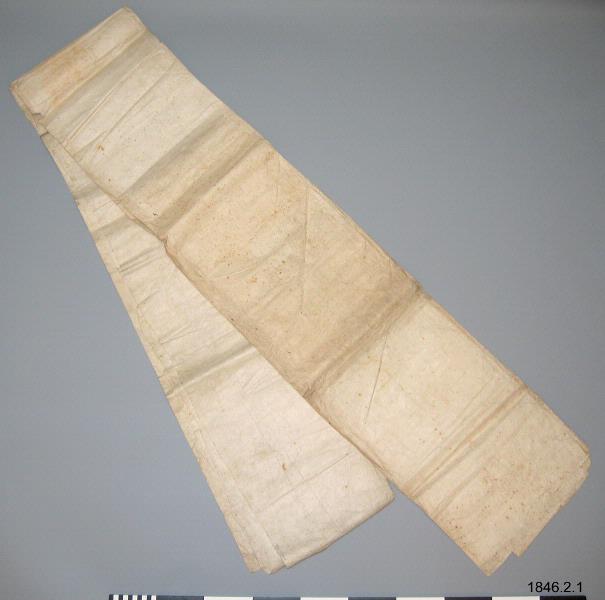
Långt, brett, rektangulärt, vitt stycke av barktyg/basttyg (kapa/tapa), ofärgat. Tillverkad av basten av Morus papyrifera. Enligt katalogkort "352 x 282 cm".
|
| Förvärvsomständigheter / till museet <itemDescription> |
|
| Anmärkning <itemDescription> |
-
Kapa is the Hawaiian term for what is more generally known across the Pacific as tapa, a barkcloth that was widely used before the introduction of European textiles. Several trees provided the raw mat...
Visa hela
Kapa is the Hawaiian term for what is more generally known across the Pacific as tapa, a barkcloth that was widely used before the introduction of European textiles. Several trees provided the raw material for kapa, including wauke (paper mulberry, Broussonetia papyrifera), mamaki (Pipturus albidus), maʻoloa (Neraudia melastomaefolia), and ʻulu (breadfruit, Artocarpus altilis). The bark was carefully cut with a serrated shell and peeled; the inner bark (bast) was separated from the outer layer, which was discarded. As in other Polynesian societies, kapa making in Hawaiʻi was traditionally the work of women. The process of making kapa varied depending on its intended use. In some cases, the bast was beaten immediately after peeling, while in others it was soaked or retted beforehand. Beating could take place in one or two stages. Hawaiʻi is one of the few regions in the Pacific where the first beating was done on a stone anvil rather than a wooden one. The cloth was dried in the sun, its edges held in place with stones. A Hawaiian tradition links kapa to the goddess Hina. The clouds are said to be her white cloths spread out to dry, weighted with stones. When she moves them, the rolling stones make thunder, and when she folds the cloth, lightning flashes across the sky. Undecorated barkcloth has often been regarded as lacking aesthetic value and, therefore, less interesting than decorated examples. Yet, in many Polynesian islands, plain and especially white tapa held remarkable significance. In Hawaiʻi, such cloths were used to wrap sculptures of the gods placed in sacred spaces. They served two purposes: to materialize the invisible presence of the deity, whose representation was hidden from human eyes, and to contain the divine power that might otherwise be too intense or dangerous. Towers were also erected within heiau (spaces dedicated to worship), wrapped with strips of white tapa to invite gods to descend into the human realm. Between October and February, ceremonies known as Makahiki were held to honour Lono, the god of fertility and peace. A tall figure representing Lono was carved, to which a large piece of white tapa was attached. Priests carried this figure around the island to receive offerings and prayers, invoking the god’s blessings. White tapa could therefore be directly associated with sacred spaces and divine beings. When priests died, they were buried with pieces of this sacred cloth. (Héloise Dazard 2025).
Stäng
|
| Anmärkning <itemDescription> |
-
Provenance: This tapa was collected by Nils Werngren (1815–1897), a Swedish sailor who completed the first Swedish circumnavigation of the world between 1839 and 1841 aboard the brigantine Mary Ann. ...
Visa hela
Provenance: This tapa was collected by Nils Werngren (1815–1897), a Swedish sailor who completed the first Swedish circumnavigation of the world between 1839 and 1841 aboard the brigantine Mary Ann. He later undertook two further voyages (1842–1844 and 1844–1846) on the Bull. Both ships were owned by the businessman Carl Fredrik Liljevalch (1796–1870), who aimed to trade in Australia. When Werngren returned from his second voyage, he learned that Brunius, purser of another ship, had disappeared with the proceeds from a cargo sale. Werngren was therefore sent on a third voyage to investigate and continue trading. The Bull departed Stockholm on 6 October 1843, sailing first to Sydney and then to Tahiti, where Brunius had settled under French protection. From Tahiti, the ship continued to the Hawaiian Islands—then known to Europeans as the “Sandwich Islands”—arriving in Maui on 3 July and O‘ahu on 4 July 1844. Unfortunately, Werngren did not record how he acquired the tapa, though he noted that “products from this island are as good as money”: tapa may have been among the items exchanged. After five weeks in Hawai‘i, the Bull sailed for Manila on 10 August 1844. Werngren returned to Honolulu from Hong Kong on February 26, 1845, remaining until April 2, 1845, and visited again from Kamchatka and the Columbia River region, anchoring at Honolulu on September 27, 1845, and departing Lahaina (Maui) on November 17, 1845. Thus, Werngren traveled between Maui and O‘ahu several times between July 1844 and November 1845, and the tapa was likely collected at one of these locations during that period. It was donated to the museum by Nils Werngren in 1846. (Héloise Dazard 2025).
Stäng
|
| Källor <itemDescription> |
|
| Källor <itemDescription> |
|
| Källor <itemDescription> |
|
| Källor <itemDescription> |
|
| Källor <itemDescription> |
-
Schattenburg-Raymond, Lisa. "A New Perspective on Understanding Hawaiian Kapa Making" in Lennard, Frances & Mills, Andy. Material Approaches to Polynesian Barkcloth. Leiden: Sidestone Press Academics,...
Visa hela
Schattenburg-Raymond, Lisa. "A New Perspective on Understanding Hawaiian Kapa Making" in Lennard, Frances & Mills, Andy. Material Approaches to Polynesian Barkcloth. Leiden: Sidestone Press Academics, 2020, p.73-81
Stäng
|
| Källor <itemDescription> |
-
Johansson Dahre, Ulf. “The South Seas objects and the development of ethnographic collections in the nineteenth century” in Naum, Magdalena & Tarnow Ingvardson, Gitte (ed.). Collecting curiosities: ei...
Visa hela
Johansson Dahre, Ulf. “The South Seas objects and the development of ethnographic collections in the nineteenth century” in Naum, Magdalena & Tarnow Ingvardson, Gitte (ed.). Collecting curiosities: eighteenth-century museum stobæanum and the development of ethnographic collections in the nineteenth century. Lund : Lund University, 2020, p.146-153
Stäng
|
| Källor <itemDescription> |
-
Neich, Roger & Pendergrast, Mick. Traditional Tapa Textiles of the Pacific. London: Thames and Hudson, 1997
|
| Geografiskt namn / annat <itemDescription> |
|
| Geografiskt namn / annat <itemDescription> |
|
| Land / engelska <itemDescription> |
|
| Geografiskt namn / annat <itemDescription> |
|
| Geografiskt namn / annat <itemDescription> |
|
| Geografiskt namn / annat <itemDescription> |
|
| Händelse / var närvarande vid <itemDescription> |
|
| Händelse <context> |
-
Ursprung i Hawaii (USA), Nordamerika.
-
Förvärvad 1846 av Werngren, Nils [[Etno]].
|
| Material, engelska<itemMaterial> |
- plant fiber
|
| Materialkategori<itemMaterial> |
- växtmaterial
- textil
|
| Material<itemMaterial> |
- bark
- växtfiber
|
| Teknik <itemTechnique> |
|
| Nyckelord <itemKeyWord> |
-
1846.02.0001
-
RM.386
-
Textil, Skinn och Fibrer (280)
-
Tyg av ospunnet material (287)
|
| Mått <itemMeasurement> |
-
Längd: 285 cm.
-
Bredd: 250 cm.
|
| Lokalt namn<itemName> |
- kapa [[Etno]]
|
| Sakord, engelska<itemName> |
- bark cloth [[Etno]]
- barkcloth
|
| Sakord<itemName> |
- tapa
- barktyg
|
| Ämne <subject> |
|
| Inventarienummer <itemNumber> |
|
| Tidigare identitet <itemNumber> |
|
| Rättigheter för metadata <itemLicense> |

|
| Källa <presOrganization> |
Statens museer för världskultur - Etnografiska museet |
|
Källa <url>
|
|

 ARTIKLAR I WIKIPEDIA
 ARTIKLAR I WIKIDATA
 BILDER I WIKIMEDIA COMMONS