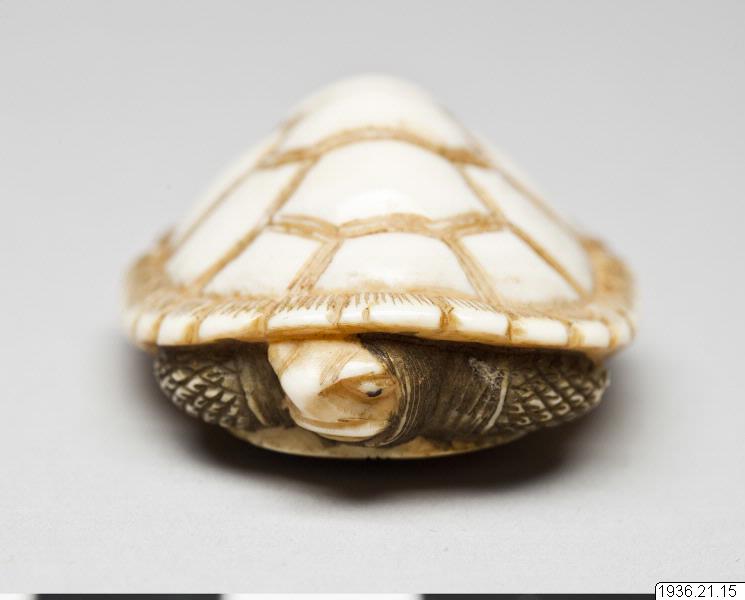
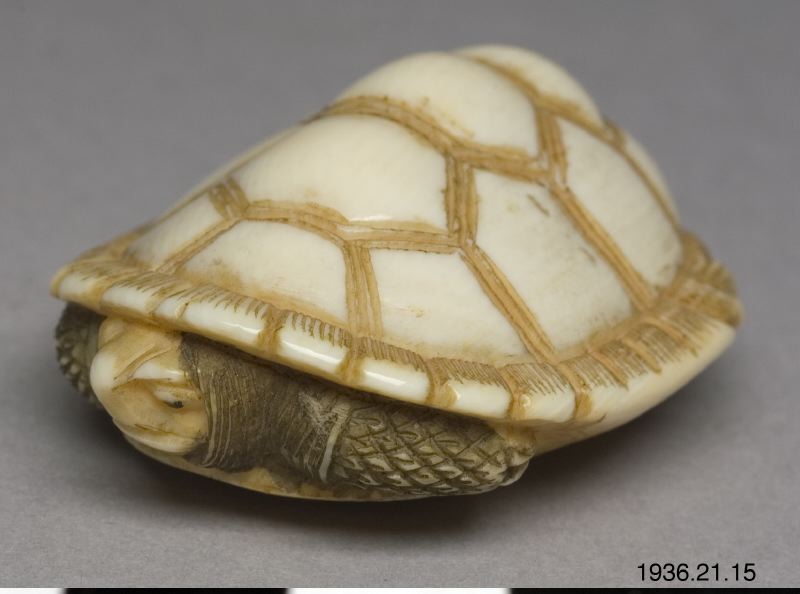
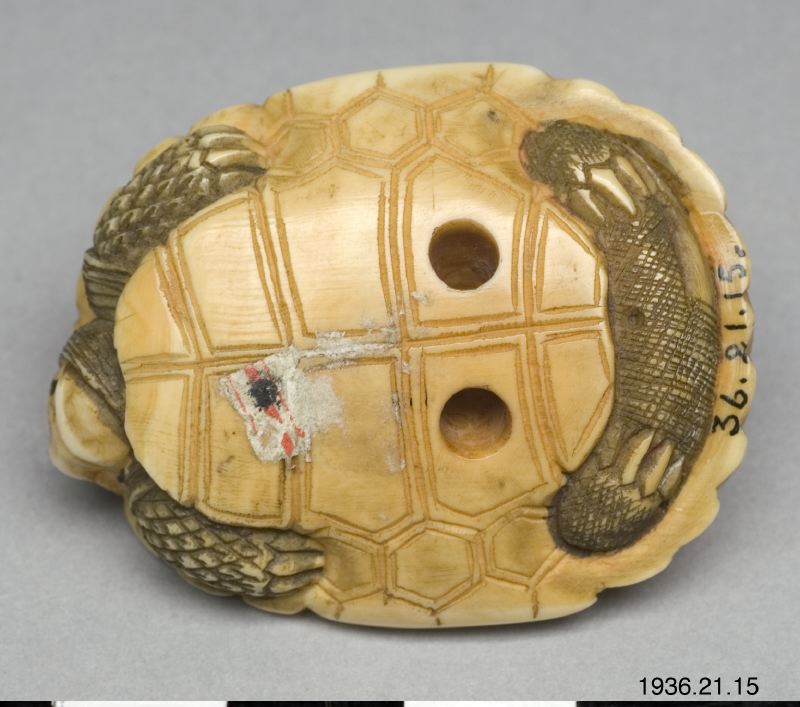
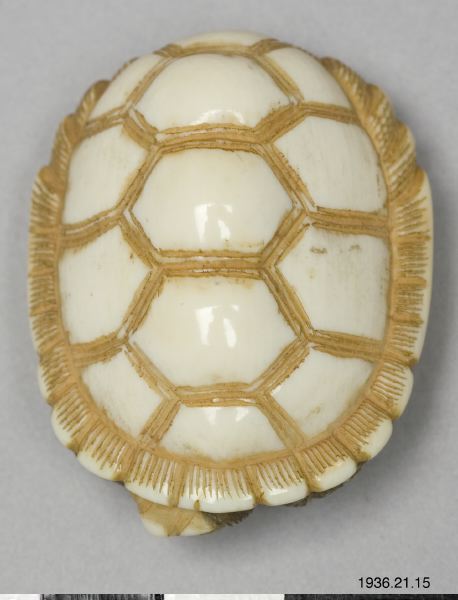
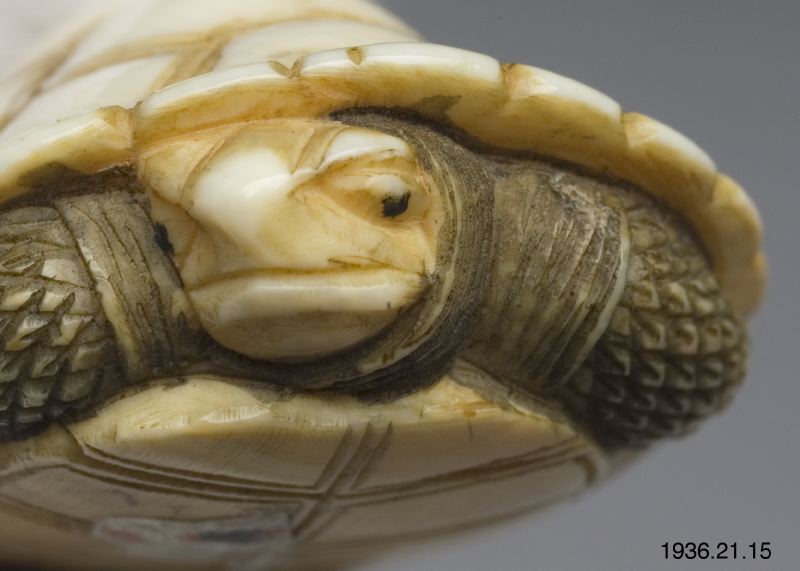
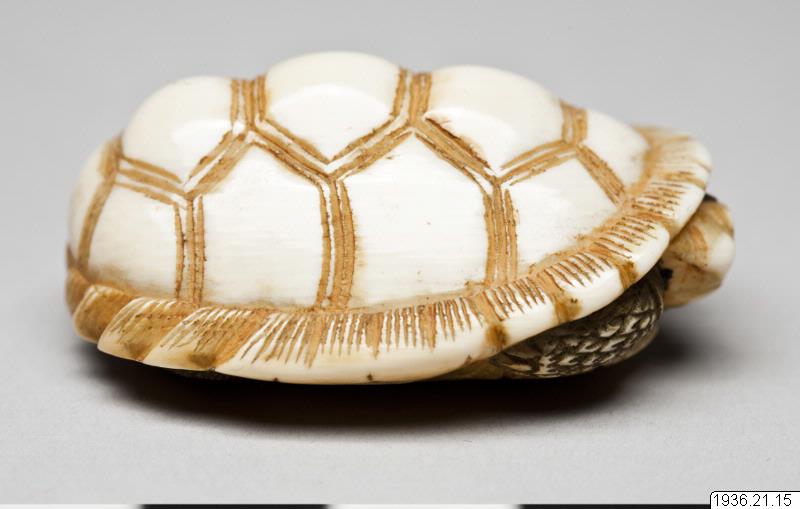
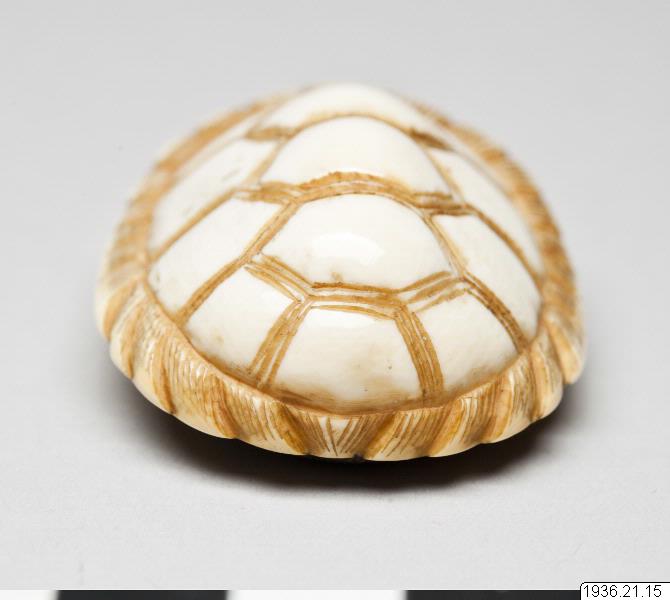
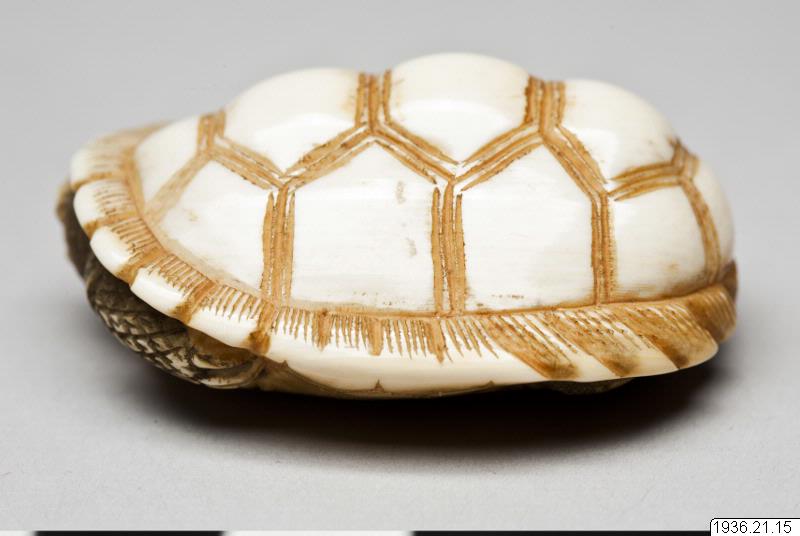
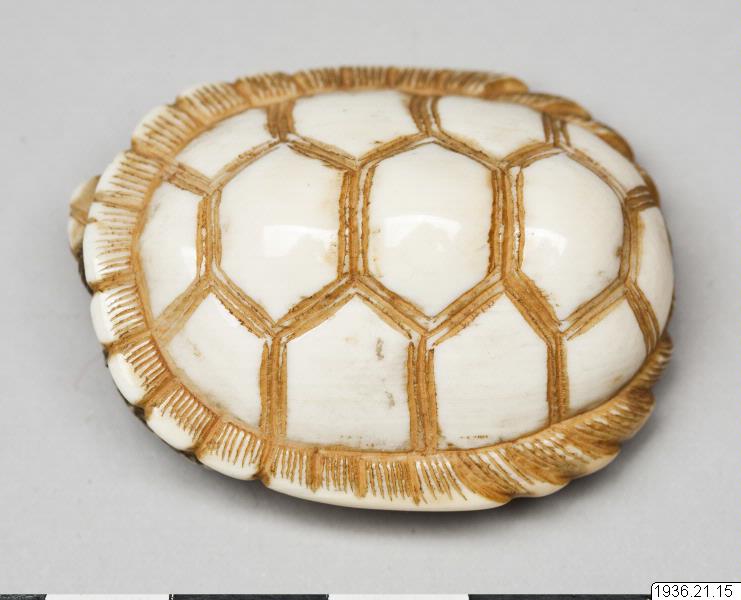
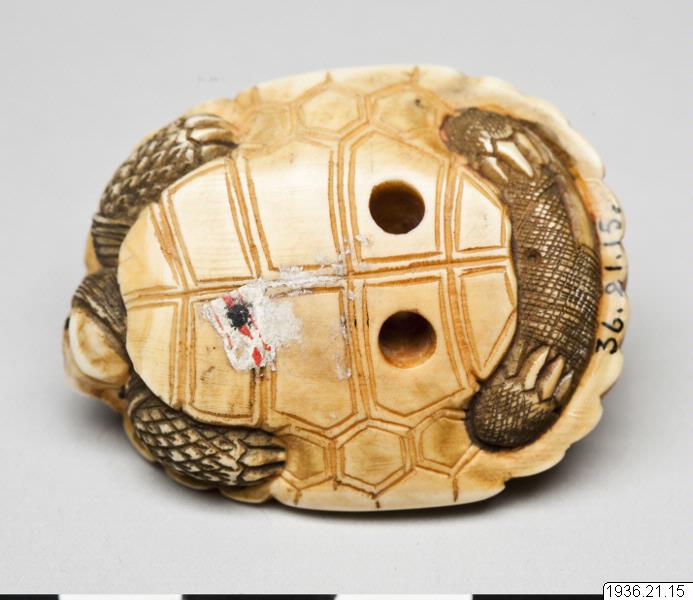
Netsuke in the form of a turtle that has retracted its head and legs under its shell. Dark eyes. In Japanese, turtles are called kame and have several meanings and associations, mainly longevity. In China and in Japan they are one of the four celestial animals and there are legends about the animal that are very reminiscent of the Hindu idea of the world resting on a turtle. The first man who evolved out of chaos had a turtle as a companion. It stands for the northern climate and represents winter as well as a star from Ursa major. In China, the first writing characters were made on its shell and it was also used as a medium for divination. It is said that there are about ten varieties, including some with connections to dragons. The one called shin kame lives for 10000 years. Those who, through a long life, have contracted sea plants and algae on their rear end, are thought to resemble an old man's beard, and are especially linked to long life. It's called Minogame in Japanese, i.e. "raincoat" turtle. (Compared to the straw raincoats of Japanese farmers.) In the hexagonal patterns on the dorsal shell can be seen the six virtues. You get a merit in life by buying turtles and setting them free. Litt.: Edmunds, W H: Pointers and Clues...London 1934, pp 637-39.
The kimono having no pockets, accessories have to be carried somehow. Women could put small objects in their sleeves and sash, whereas men, mainly, would hang their various boxes, pipes and brush cases on a cord at their belt. The portable objects are called sagemono. Accessories became identity-forming status objects and an important part of men´s fashion, a world in miniature with a wealth of subjects. Various kinds of artistically crafted sagemono are known from the 17th century. In addition to boxes for tobacco, cases for personal seals (inro) are one of the best-known types. Literally translated, an inro is a basket (ro) containing a seal (in). Only sealed signatures were legally valid, and so samurai and merchants, for example, needing seal stamps had to carry them in small cases. This was the origin of “seal baskets” (inro), which soon came to be used primarily for carrying medicine. These accessories varied in appearance according to the wearer’s taste and wealth, as well as fashion trends. When Western dress became popular during the Meiji period (1868-1912), there was less need for these portable objects, and they were divided up into their constituent parts (with toggles kept apart) and sold to westerners.
(Based on the text for the exhibition catalogue Japan. Artefacts and images tell the story. 2011).
The function of the netsuke item is to be a counterweight to the "hanging things" (sagemono) worn with the kimono by the men. Common hanging items were various boxes, for example medicine boxes (inro) and tobacco pouches. Netsuke roughly means "fixed root" and early netsuke (before the late 17th century) were probably natural, unprocessed roots and the like. From the 18th century they were made more representative and often in wood or ivory. Eventually, the artists began to sign their netsuke.
(Based on the text for the exhibition Japan. Artefacts and images tell the story. 2011). /PH

 ARTIKLAR I WIKIPEDIA
 ARTIKLAR I WIKIDATA
 BILDER I WIKIMEDIA COMMONS





